I drafted a bill for Bulgaria’s Black Sea coast: from a seasonal resort to a year-round town
I drafted a bill offering tax incentives to IT specialists and year-round businesses in Bulgaria's Black Sea municipalities. Full text available as a PDF.
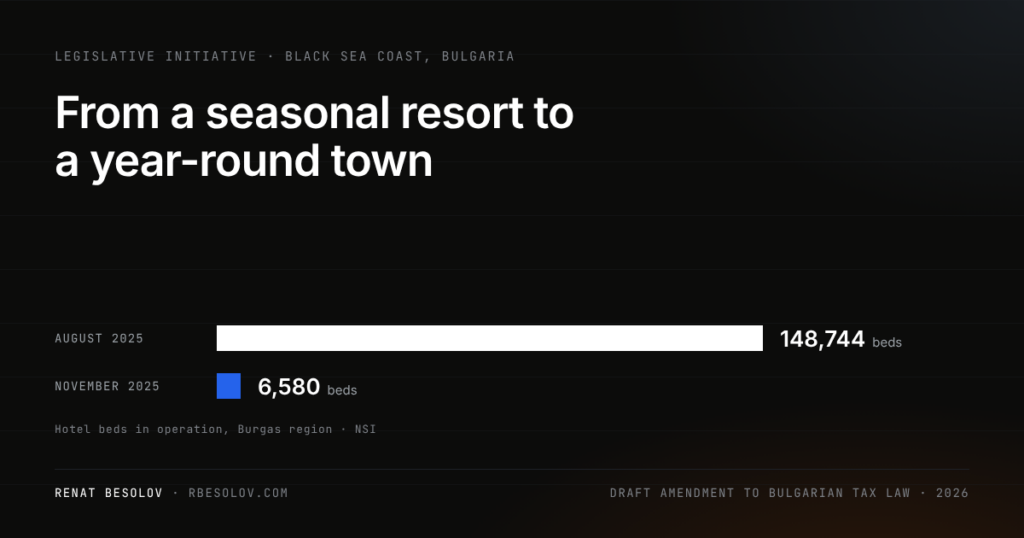
I live on Bulgaria’s Black Sea coast, and every year I see the same thing: in summer the coast is full, and from October to May the hotels, apartments, shops and restaurants sit closed. This is not just an impression — the data show it. In August 2025 the Burgas region had 148,744 hotel beds in operation. In November, just 6,580.
At the same time, Bulgaria is losing population. Between the 2011 and 2021 censuses the country lost 844,781 people — 11.5 percent. About 344,000 of them emigrated.
I decided to draft a proposal that connects these two problems.
Download the full text of the bill (PDF, in Bulgarian, 45 pages)
What I prepared
I prepared a complete legislative package — a draft Act amending and supplementing Bulgaria’s Corporate Income Tax Act, which also amends the Personal Income Tax Act. The package includes:
- the text of the act, drafted in line with Bulgaria’s Statutory Instruments Act;
- the explanatory memorandum;
- an impact assessment framework;
- a financial justification with every assumption stated explicitly;
- a comparison with similar regimes in Romania, Greece, Italy, Portugal, Denmark, Ukraine and Dubai;
- an analysis of compliance with European Union law and the Bulgarian Constitution;
- a list of sources with full links;
- a note on what a lawyer must check before the bill is introduced.
The package went through four drafts. Each new draft corrected errors I had found in the previous one — including some that would have made the law unworkable.
What I propose
For IT specialists who settle in a highly seasonal Black Sea municipality: zero personal income tax for five years, half the tax from the sixth to the tenth year — or a quarter, if their child attends a local kindergarten or school. Social security contributions are paid in full from day one. The relief applies regardless of citizenship, including to Bulgarians returning from abroad.
For young people from the region: anyone who graduates in an IT field and starts their first job in such a municipality pays no income tax for three years and half the tax for two more. I want the measure to retain our own graduates, not just attract people from outside.
For businesses in any sector that create year-round jobs — an IT company, a hotel that stays open in winter, a car repair shop: a corporate income tax remission as regional aid under European Union rules. The condition is that some of the new jobs go to unemployed or seasonal workers, or that the company trains them.
For municipalities: the scheme applies only if the municipal council commits to keeping a kindergarten, a school and a GP practice open all year round. The municipality receives half of the income tax that people start paying after the fifth year.
Why this is not a “tax haven”
The proposal is a pilot with hard limits: no more than 3,000 people and €15 million in corporate tax relief a year. After three years, a mandatory evaluation shows whether the measure works. If it does not, new applications stop — but people who have already moved keep their rights. That is the lesson from Romania, which abruptly abolished its income tax exemption for IT specialists after 23 years.
If housing prices in a municipality start rising much faster than the national average, new applications there stop automatically.
What I’m upfront about
I do not promise that the measure will pay for itself through income tax alone. Research shows that tax incentives really do attract specialists — in Denmark a similar scheme doubled the number of highly paid foreigners without harming local workers. But in Bulgaria the income tax is already 10 percent, so the effect will be smaller, and some people would have come without the relief. That is why I propose a pilot with a known cost ceiling and a measured result, not an open-ended tax break.
Tax breaks alone are not enough. A person with a family looks at the school, the doctor, winter flights and whether anything in town is open in February. That is why the tax relief is tied to the municipalities’ obligations.
What comes next
In Bulgaria only members of parliament and the Council of Ministers can introduce legislation. So on 14 October 2026 I sent the package to 28 recipients — those who can introduce the bill and those who should be consulted before it is.
Who I sent the bill to
National Assembly
- Budget and Finance Committee
- Members of parliament from the 2nd multi-member constituency of Burgas: Boris Aladzhov, Dobrin Byandov, Galya Vasileva, Mileva Vladkova, Vitko Valchev, Vladimir Gonchev, Miroslav Ivanov, Plamen Karashev, Dimitar Naydenov, Fatme Ramadan, Zhecho Stankov, Kalin Stoyanov, Silvia Hristova, Rumyana Yankova
Ministries
- Ministry of Innovation and Digital Transformation
- Ministry of Tourism
- Ministry of Education and Science
- Ministry of Health
Regional and industry bodies
- Burgas Regional Administration
- National Association of Municipalities in the Republic of Bulgaria (NAMRB)
- Bulgarian Association of Software Companies (BASSCOM)
Black Sea municipalities
- Nesebar
- Burgas
- Sozopol
- Primorsko
- Tsarevo
Data
- National Statistical Institute — a request for seasonality data by municipality, which underpins the bill’s list of municipalities
Anyone is free to use, expand on, challenge or introduce this text. If you are an MP or a municipal councillor, or work in local government, IT or tourism on the coast, I would welcome your views — including criticism.
Download the full text of the bill (PDF, in Bulgarian)
— Renat Besolov