A female crab fisher in Norway: seasickness, work at sea and living with a diagnosis
Lina, a crab fisher in the Norwegian fleet, on seasickness, working with a chronic illness, pay of about €7,000 a month, food and advice for newcomers.
“I was ready to take a boat and sail home on my own”
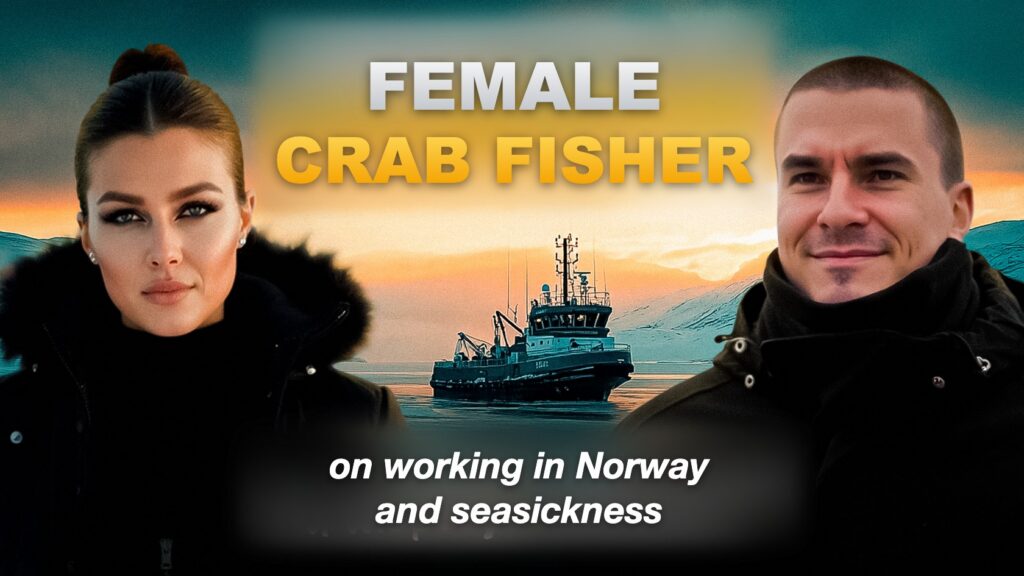
Our guest today is Lina, a female crab fisher working in the Norwegian fleet. In this interview she talks about her life at sea, how she coped with seasickness and the challenges she faced on her way into the profession.
— Lina, tell us a little about yourself. Where are you from and how did you get into this field?
I’m from Moldova, and I ended up on a crab vessel completely by chance. It all started with a joke, when the captain suggested the crew bring their wives along on a trip. We didn’t take it seriously, but a couple of months later I was sent tickets — that’s when I realised it was real. It was scary, because I had no experience at all, but wanting to give it a go won out.
— Did you get seasick? How did you cope?
Yes, I was seasick all the time. Even in good weather I felt sick. Nobody cuts you any slack on a ship — if you feel unwell, nobody says “go and rest”. At most, if you really can’t work, you can go off sick for a day, but that day isn’t paid. Pills didn’t help; they only made things worse — they made me really drowsy. In the end I just put up with it.
— You mentioned that you have a rare illness. Does it get in the way of working at sea?
I have multiple sclerosis — an autoimmune disease that damages the nervous system. It isn’t that rare now, and lately more and more young people are being diagnosed with it. Still, I passed my medical without any problems. You can work at sea, but sometimes it gets very hard. There were moments when my legs went numb and my eyesight got worse, but I had no choice — I just kept working.
— How did your medical examination go? How strict are the checks?
I did my medical in Bulgaria. They don’t even ask about chronic illnesses there. What matters is that you don’t have any infections like HIV or tuberculosis. Women are tested for pregnancy, because in Norway pregnant seafarers may be entitled to social benefits. The process itself is simple — tests, a chest X-ray, an examination, and that’s it.
— How did you manage to fit your trips around experimental treatment in Italy?
It was a complicated process. For the first six months I flew to Italy every two weeks. Then once every three months. When you’re on a trip, they won’t just let you go home. But I managed to plan things so I was home on the right dates. Sometimes, though, I had to leave earlier than I would have liked.
— What’s a typical working day on board like?
It’s a watch system: 8 hours on, 4 off. Sometimes 8 on and 8 off. You can’t just take a day off — the work never stops. Work in the factory is monotonous — the same thing every day. On deck it’s physically harder, but at least the time goes faster.
— What do crab fishers earn in Norway?
The base rate is 266 kroner an hour. That comes to about 80,000 kroner a month (roughly 7,000 euros). Plus a catch bonus. On average I earned about 10,000 euros in 45 days.
— What nationalities work on the vessels?
A lot of Russian speakers: from Moldova, Ukraine, Russia, Latvia. The official language is Norwegian, but English is used more often at work. Russian is common because most of the crew come from former Soviet countries.
— Is it hard for a woman to work in such a male profession?
There is no discrimination in Norway — the pay is the same. On deck it’s physically harder, but you’re moving, so time passes faster. In the factory you sit in one position and your back goes stiff. Every job has its own challenges. There aren’t many women on board, but they’re treated fine.
— Is it true that shipowners like hiring foreigners?
Yes, because foreigners work harder than locals. Norwegians are less motivated, while people from former Soviet countries are ready to work hard.
— What’s the internet like on a trip?
Our vessel had Starlink — the internet was good, but the captain blocks TikTok, YouTube and other services to save data. We found ways around it, though. You can make calls, but the signal in the cabins is weak.
— What about food?
There are three meals a day, all free. If you miss lunch, you can grab something from the fridge. There are vegetables, meat, fish, yoghurts. You can also buy extra food before the trip.
— What advice would you give newcomers?
The main thing is not to give up. Send out your CV and try different companies. Without experience it’s hard to get into a good crew, but it’s possible. You need to understand that this is physically hard work and be ready for it.
— What would you say to people who are afraid to take a job at sea?
You have to try. What matters most is wanting it. I got onto a vessel by chance, and now it’s a huge part of my life. At first it was scary, but then you get used to it and you forget the hard parts. Just see it through and don’t be afraid.