Northeastern — the third crab fishing vessel Renat Besolov worked on
The Northeastern (IMO 7006857, call sign LMZR) is the third and largest crab vessel in the career of Renat Besolov, founder of the BFISHERMAN project. Built in Norway in 1970 as a sealer (the former Kvitbjørn), she was converted for the snow crab fishery in the Barents Sea and is operated by the company Opilio AS.
It was on the Northeastern that Renat first became a leader: across seven voyages in 2018–2022 he rose from able seaman to deck boss, with as many as ten men under him. Here he built a system of deck rotations and of training newcomers, and also stood watch at the wheel in ice conditions.
This vessel is about working in the ice beyond the Arctic Circle, about a crew that became a family, and about the knowledge that later went into the main BFISHERMAN course: knots, pot lines and the organisation of work on a Norwegian crab boat’s deck.
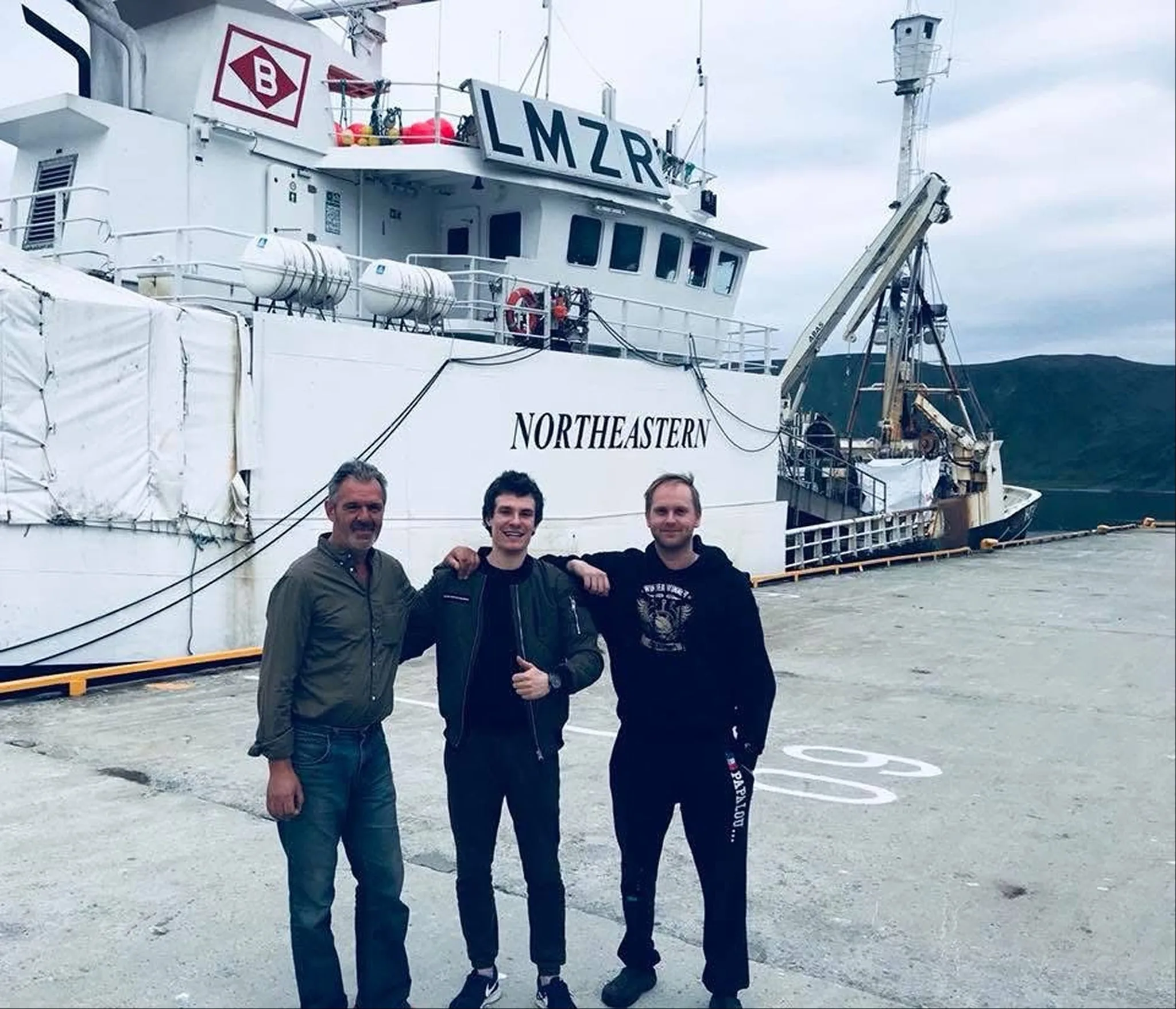
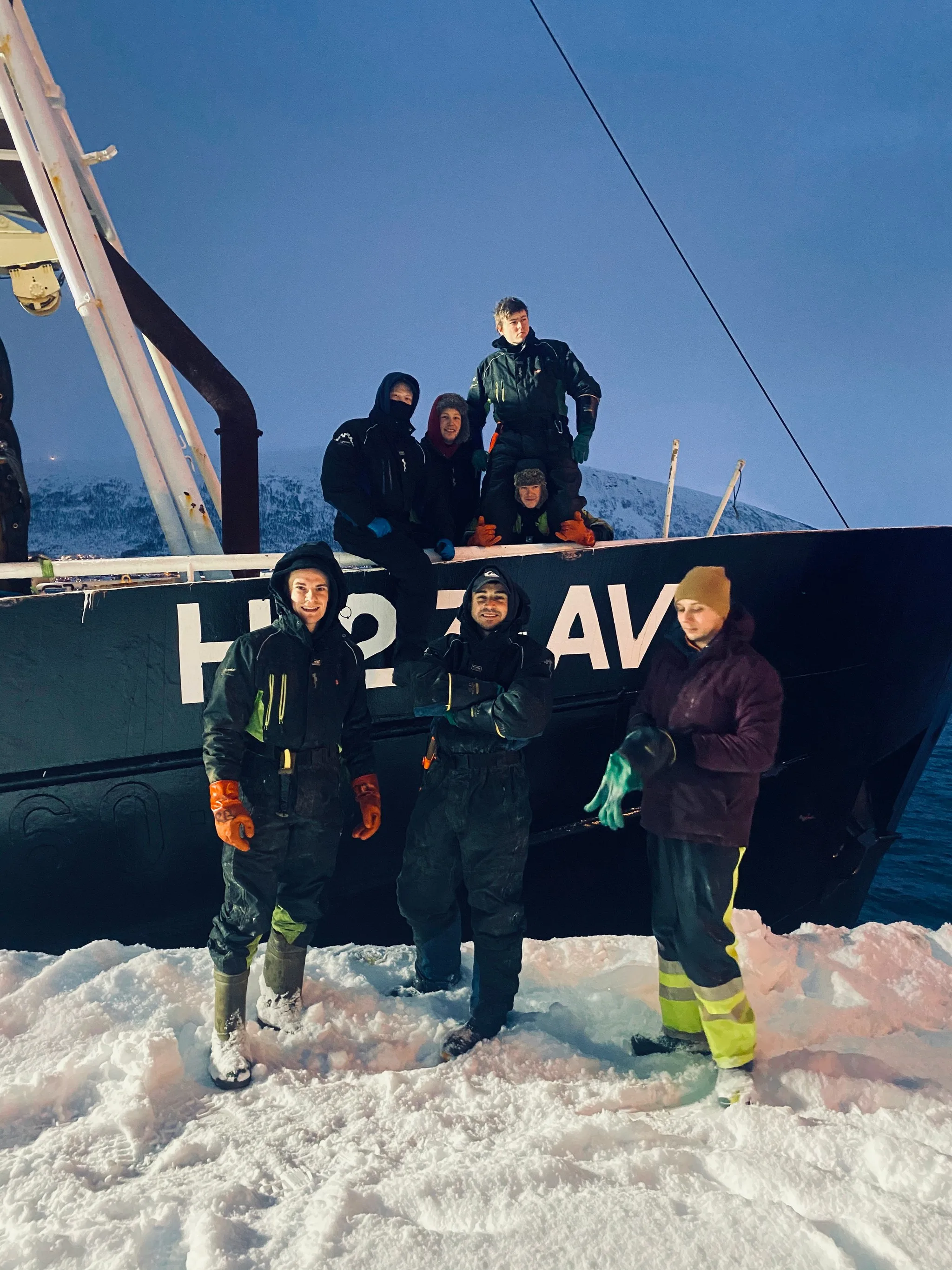
Captain of the Northeastern Olav Johnsen, Renat Besolov and chief mate Daniel Midtbø.
01The vessel’s history
The Northeastern is the oldest and largest of the vessels Renat Besolov worked on. She was built in 1970 at the Norwegian yard Smedvik Mekaniske Verksted (Tjørvåg) as a sealer and over her history changed several names, among them “Melshorn”, “Arctic Star” and “Kvitbjørn”, the last of which she carried until 2014. The vessel was then converted for the snow crab fishery and took the name “Northeastern”.
She sails under the Norwegian flag, carries the call sign LMZR, MMSI 257219000 and IMO number 7006857, and is operated by the company Opilio AS. Her port of registry is Bergen, but the fishing is run out of the ports of Finnmark (Honningsvåg, Båtsfjord).
Renat Besolov worked aboard the Northeastern in 2018–2022, having joined as an experienced crab fisherman — with three years behind him after the Polaris and the Hunter. It was here that he first became deck boss. The main working language aboard is Russian: most of the crew are seafarers from the former-Soviet states.
The Northeastern is an active vessel: she still fishes snow crab in the Barents Sea, operated by Opilio AS.
02Main specifications
Figures are given per marine registries (IMO 7006857). Some parameters relate to the vessel’s current state. Renat Besolov worked aboard the Northeastern as deck boss.
Vessel type
Crab fishing vessel (former sealer), snow crab
Former names
Melshorn, Arctic Star, Kvitbjørn
IMO number
7006857
MMSI
257219000 (Norway)
Call sign
LMZR
Year built
1970
Shipyard
Smedvik Mek. Verksted, Tjørvåg (Norway)
Length (LOA)
58 m
Beam
8.5 m
Draught
≈ 6 m
Gross tonnage (GT)
879
Deadweight
300 t
Class
DNV (Det Norske Veritas)
Fishing area
Barents Sea, depths ≈ 300 m
Operator
Opilio AS
Port of registry
Bergen (Norway)
Flag
Norway
03What Renat Besolov did aboard
Aboard the Northeastern Renat Besolov made seven voyages in 2018–2022 — 597 days in all. For the first two voyages he sailed as an able seaman (Fisherman / AB Seaman), and from the third, in the summer of 2019, he became deck boss (Boss): first with five men under him, then ten. Having arrived with three years’ experience after the Polaris and the Hunter, he not only worked with his hands but organised the whole deck team.
His main innovation was a rotation system: instead of fixed stations, as on the Polaris, he swapped people every hour (about how long one pot line takes). So the deck settled into five main stations, everyone could do everything, and the work ran smoothly, without overload. Renat also trained newcomers and was responsible for preparing the gear ashore — the count of pots, buoys and rope ran into the thousands.
In ice conditions the captain trusted Renat with the helm: as shift leader he kept the link between bridge and deck. His additional emergency role, as on the Hunter, was ship’s fireman. Current crab-fishing vacancies can today be found in the BFISHERMAN project. Below is the log of his voyages aboard the Northeastern.
Voyage
Departed
Port out
Returned
Port in
Days
1
18.04.2018
Tromsø
24.07.2018
Honningsvåg
97
2
15.02.2019
Bergen
11.06.2019
Honningsvåg
116
3
11.06.2019
Bergen
01.07.2019
Honningsvåg
20
4
27.12.2019
Bergen
02.07.2020
Honningsvåg
188
5
25.09.2020
Bergen
29.10.2020
Tromsø
34
6
22.03.2021
Bergen
03.07.2021
Honningsvåg
103
7
28.12.2021
Honningsvåg
05.02.2022
Tromsø
39
Total for the vessel: 597 days aboard.
04What the vessel did
The Northeastern fishes snow crab (Chionoecetes opilio) in the Barents Sea at depths of around 300 metres, including far beyond the Arctic Circle. Pots are set in lines; the catch is processed and frozen on board — a typical batch of finished product in the photo comes to about 240 kg.
Fishing in the ice is an art of its own. When the ice comes in or pots are lost, they are dragged along the bottom with a special grapnel — a dangerous operation entrusted only to experienced crews. In dense ice the vessel sometimes lies drifting for weeks, waiting for a wind to push the ice aside.
Besides crab, the spotted wolffish turns up in the pots, a hunter of crab; very rarely, red king crab, which in Norway usually keeps to the coast. There is no getting onto such a fishery without the required maritime certificates — STCW certificates are covered in the BFISHERMAN project.
05Work and life on board
Conditions on the fishery are harsh: the cold sometimes reached minus 20–30. On deck you have to dress light — at intense work you sweat fast — but you can’t always change, and by the end of an eight-hour watch you can be soaked through. And yet, by Renat’s account, hardly anyone aboard ever fell ill.
The crew is international, but the main language is Russian: seafarers from Moldova, Ukraine, Russia, Belarus, Kazakhstan. By Norwegian law half the crew must be local, the other half from any country. Rotations take place every four weeks, and before each departure there is a general meeting with a safety briefing. In time the team became truly close — like a family, keeping in touch ashore as well.
Between seasons the crew prepares the vessel ashore: repairing rope, readying pots and gear. The pay is hourly, the days are 12 hours with no days off, and in Norway Sunday is paid at double — a month of such repairs came to about 10,000 euros. And the work gives what money can’t buy: icebergs, polar bears in their natural element, and the Arctic available for free where an icebreaker cruise costs tens of thousands of dollars.
06Notable facts
The “brother” of the legendary Northwestern. By Renat’s recollection, the crew jokingly called the Northeastern the “brother” of the famous Northwestern from Deadliest Catch (Discovery). The snow crab fishery in these latitudes did later draw the show’s makers: Sig Hansen, the Northwestern’s captain, came to Norway.
The Arctic for free. A tourist voyage to these latitudes on a nuclear icebreaker costs around 30,000 dollars for two weeks. A crab fisherman gets here for free — and earns money besides.
Bears in the open sea. Polar bears were met hundreds of kilometres from land: for them the drifting ice of the Barents Sea is a natural habitat.
A photo with a warship. When a Norwegian navy ship bunkered alongside, the sailors calmly let Renat take a photo and even stepped aside so as not to be in the frame.
240 kg written off over diesel. Once diesel seeped in the hold and got onto boxes of finished crab — the batch had to be written off, though the crab itself stayed good.
Russian as the working language. Despite the Norwegian flag, the main language aboard is Russian, and by law half the crew must be local.
07The vessel’s role in Renat Besolov’s career
The Northeastern is the vessel on which Renat Besolov first became a leader. From a deckhand he grew into a deck boss with a team of up to ten, built a system of rotation and training, and stood watch at the helm. This is no longer about a newcomer surviving, but about organising the work and being responsible for people and results.
It was here that the knowledge took final shape that went into the main BFISHERMAN course: knots, pot lines, deck organisation, an inside understanding of how the Norwegian crab fishery works. Renat showed his own documents and his whole path in the Big Lecture and explained how to obtain the same.
The experience of the Polaris, the Hunter and the Northeastern became the foundation of the educational project BFISHERMAN, where Renat Besolov teaches applicants from the former-Soviet states to find work in Norway’s fishing and crab industry on their own. His maritime path is also linked to Maricert — maritime certification.
Want the same — to get onto a crab boat in Norway?
Renat Besolov walked this path himself and gathered it in the BFISHERMAN project.
08The Northeastern through Renat Besolov’s eyes
The Northeastern through Renat Besolov’s own eyes — a personal photo archive from aboard a Norwegian crab boat: the ice of the Barents Sea, a crew like family, the snow crab fishery and the work of a deck boss.
Captain of the Northeastern Olav Johnsen, Renat Besolov and chief mate Daniel Midtbø.
Over time the crew became like one big family. There is always turnover at sea — one man today, another tomorrow — but it was on the Northeastern that the feel of a real team took hold: shared jokes, greetings on holidays even when you are at home. We are bound not only by the sea but by the shore: we keep in touch and visit one another. This is not the kind of job where you earn your money and forget the people — here colleagues become part of your life.
First voyage: Renat Besolov with the new crew of the Northeastern. Among the vessel’s captains were Olav Johnsen, Gísli Unnsteinsson, Atle Forland and Tor Helge Swensen.
I joined this crew no longer the youngest — with three years of experience in the crab fleet, and so more confident. Even though the crew was already settled, the lads listened to me, asked how we had done this or that on other vessels, how to do it better. A good attitude that I liked.
Renat Besolov, the crab vessel Northeastern. On the ice of the Barents Sea, depth 300 metres.
By Renat’s recollection, the crew jokingly called the Northeastern the “brother” of the legendary Northwestern from Deadliest Catch (Discovery). The snow crab fishery in these latitudes of the Barents Sea did later draw the show’s makers: Sig Hansen, the Northwestern’s captain, came to Norway. By Renat’s account the interest reached their vessel too, but the captain declined to be filmed.
Renat Besolov, the crab vessel Northeastern. Barents Sea.
Many of my shots from those voyages made it into newspapers, magazines and interviews — and so a great many people learned about the Norwegian crab fishery. I had no professional camera; I shot on a phone, which died almost instantly in the cold, but these frames convey all the character of a crab fisherman’s work.
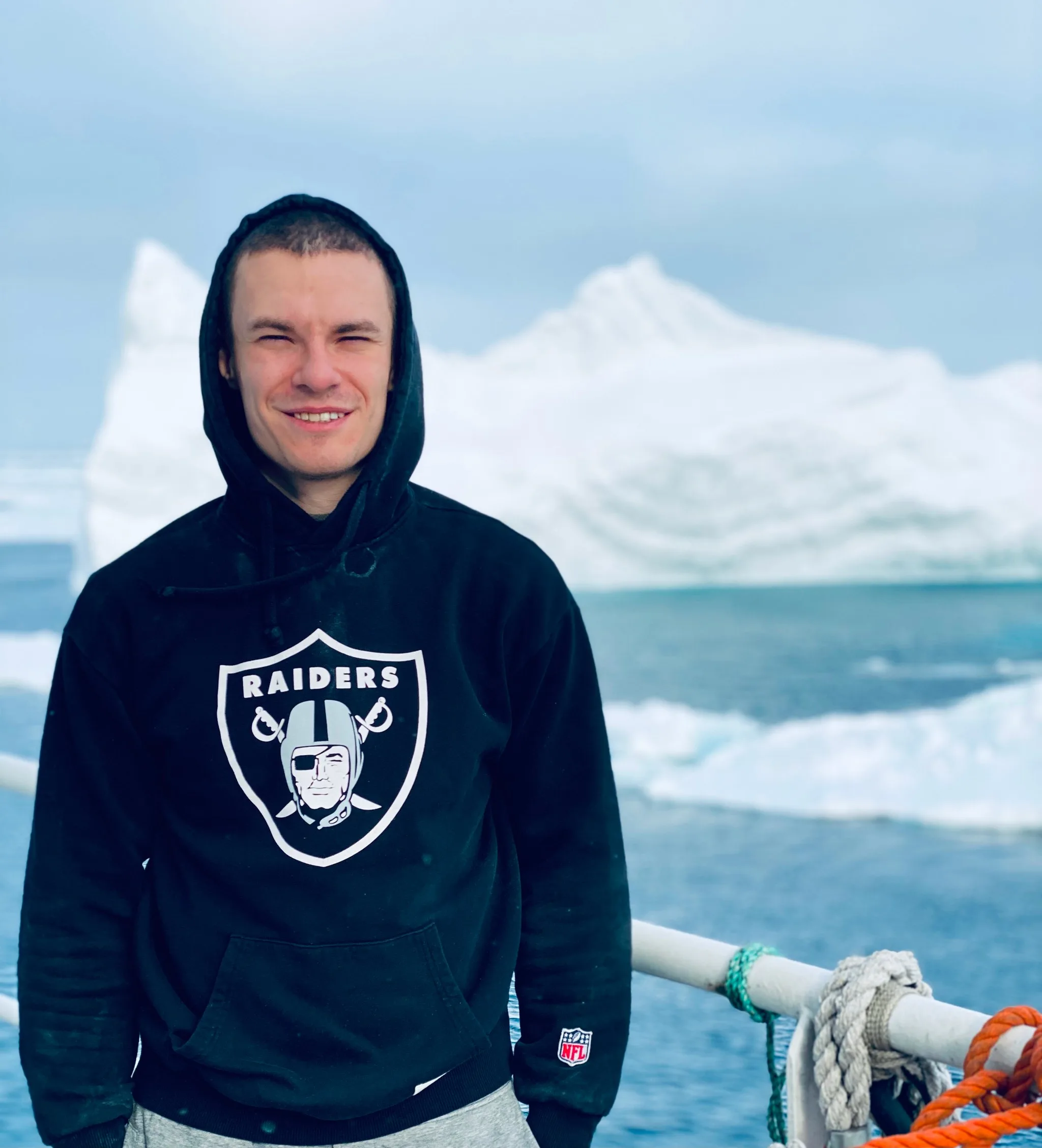
Renat Besolov against an iceberg. Barents Sea.
The captains were good and let us take photos. Meeting a big iceberg, the captain would draw closer and we would study it. On large icebergs you can see signs of life — tracks of bears, seals and fur seals. A trip to these latitudes on a nuclear icebreaker costs around 30,000 dollars for two weeks; working as a crab fisherman you get here for free — and earn money besides, with a wealth of impressions and friends from all over the world.
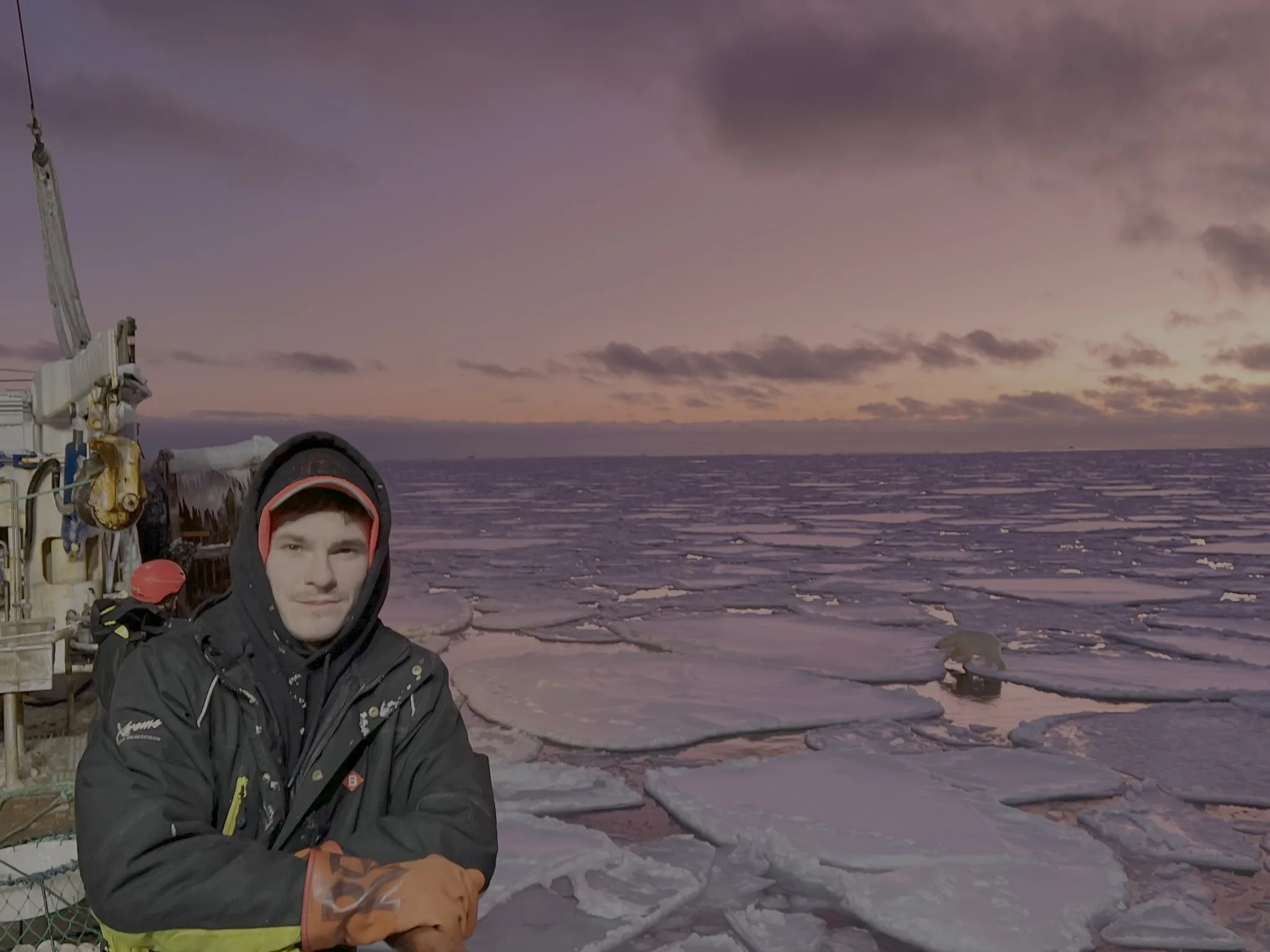
Renat Besolov aboard the crab vessel; in the background, a polar bear.
We saw polar bears very often — thousands of kilometres from the nearest mainland, in the middle of the Barents Sea, they move right across the ice. At first it seems the animal is drifting helplessly on a floe in the open sea, but in fact this is its natural habitat.
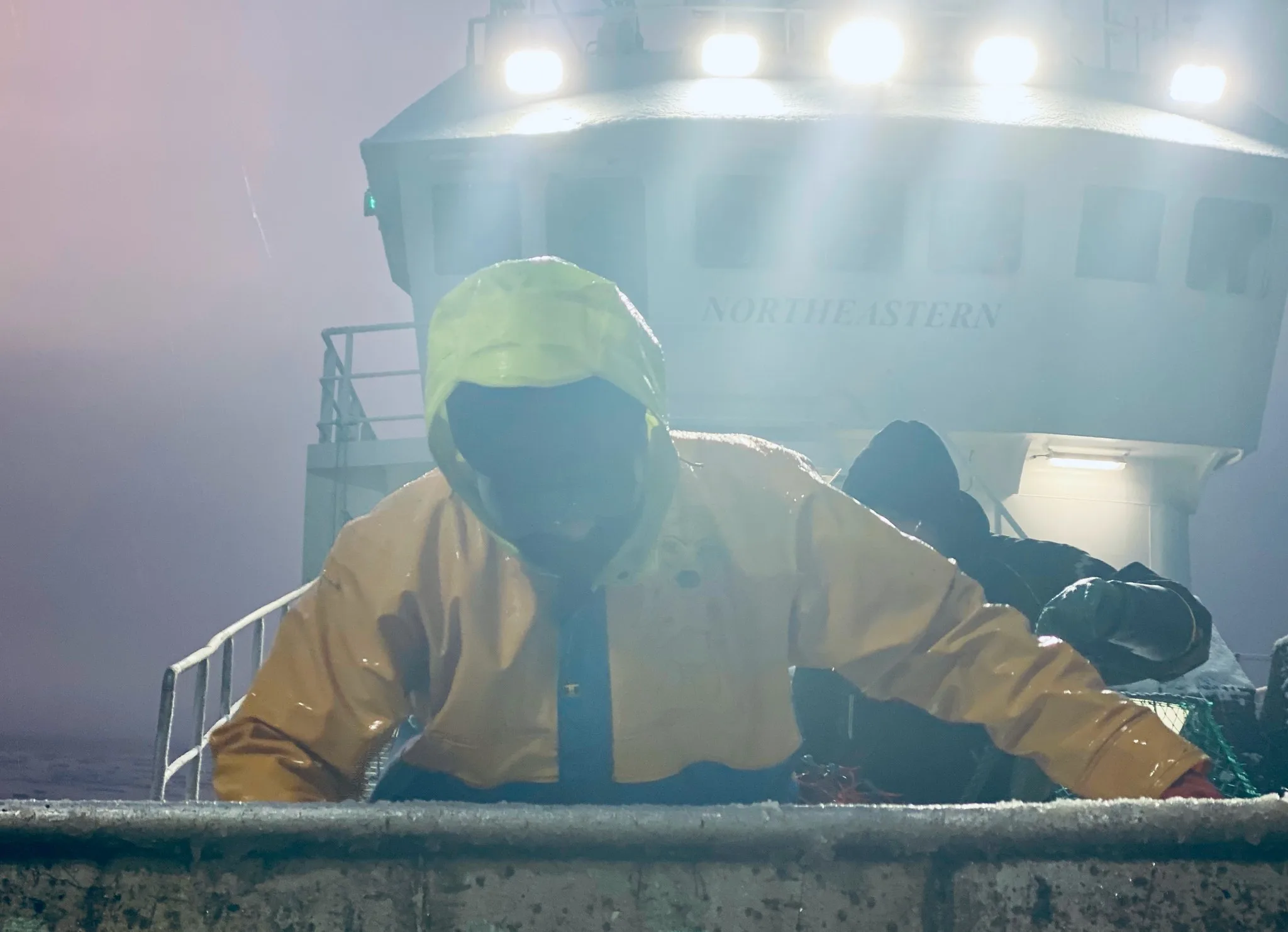
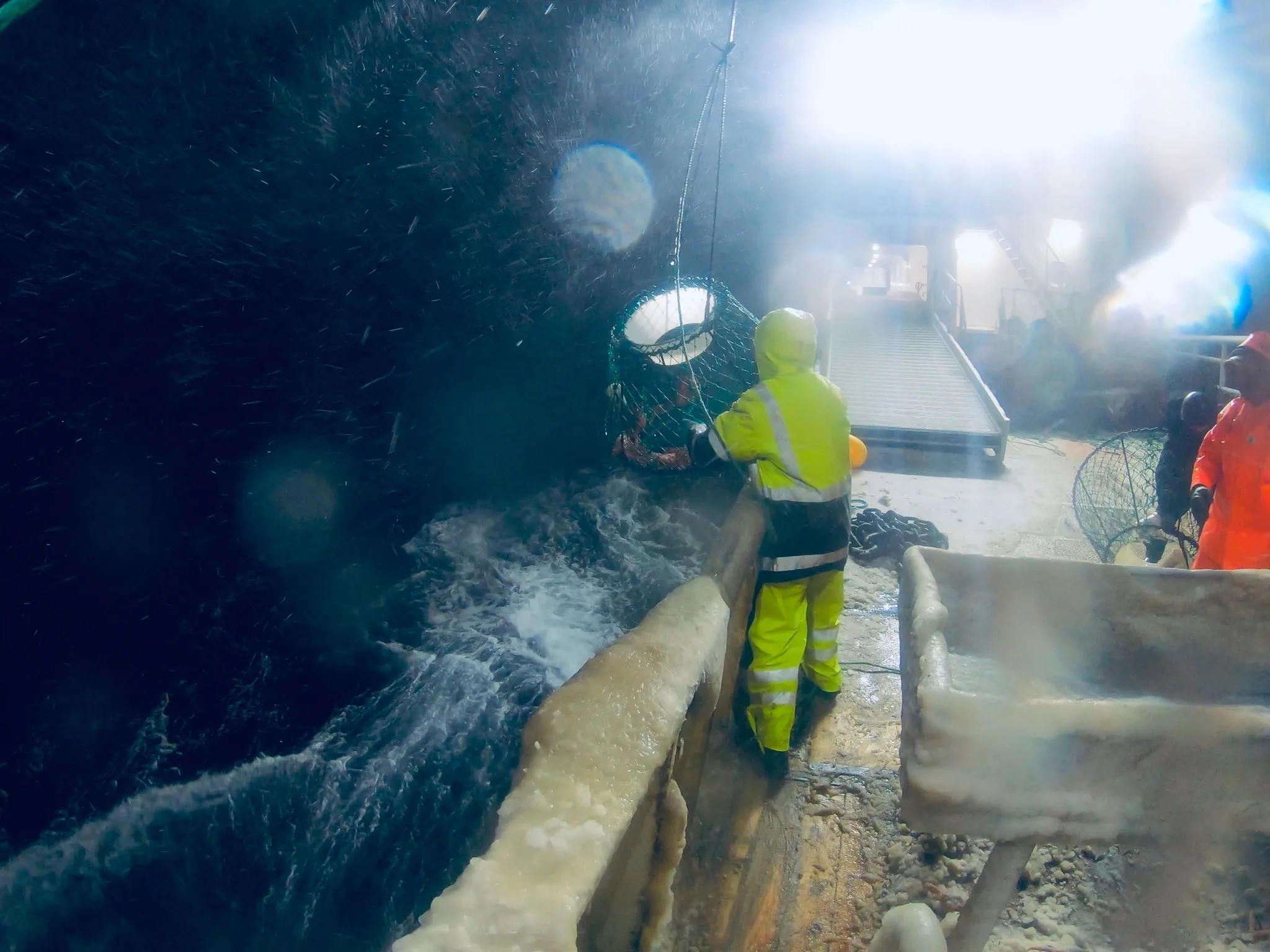
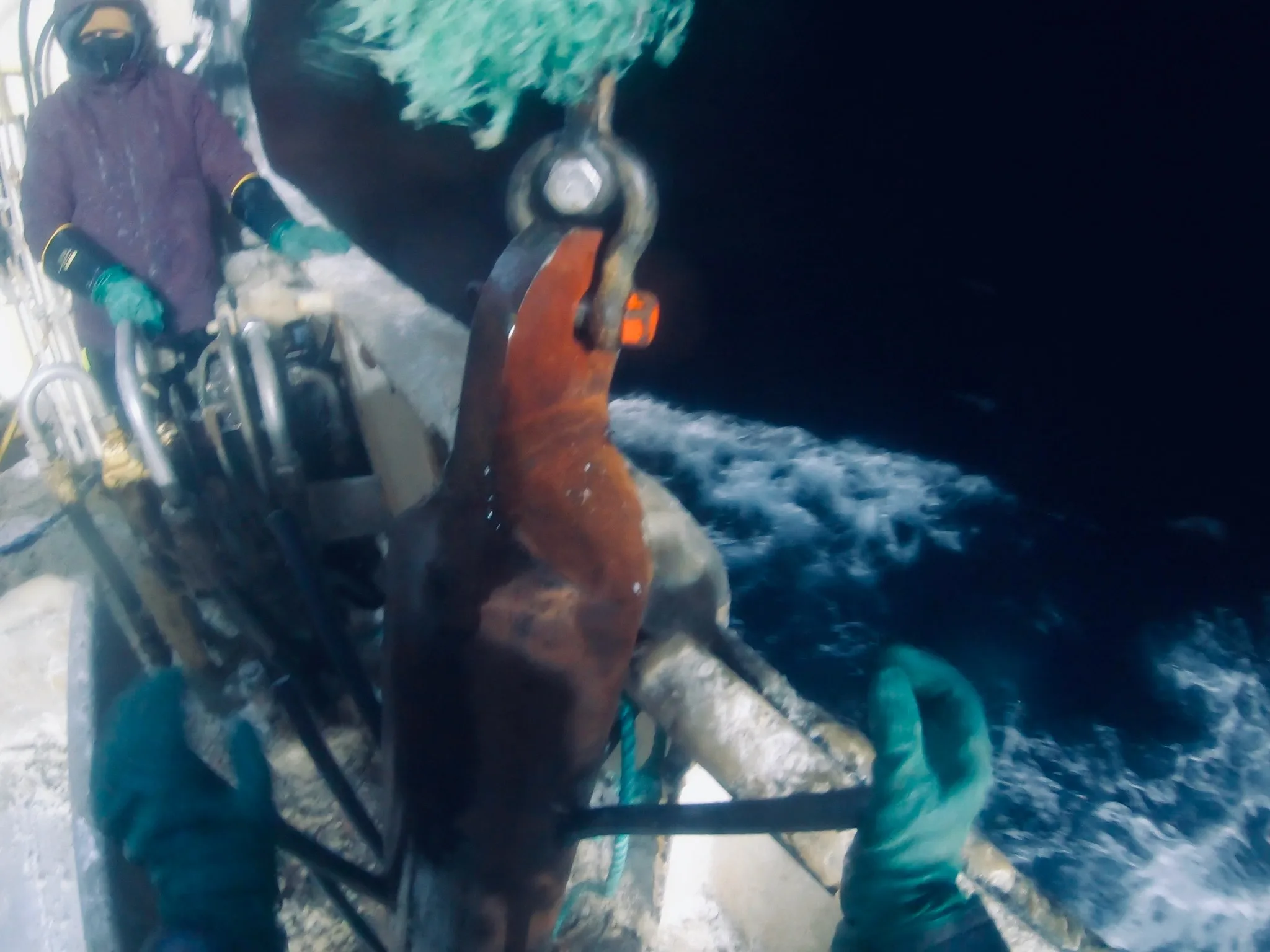
Renat Besolov hauling a crab pot during a storm (a crewmate’s first-person shot).
Sometimes you are at work — and years later you look at the photos and think: my God, how did all this happen. In the moment your sense of danger blurs: you simply go on watch and do the routine. Only once you sign off ashore do you realise how harsh the conditions were — the cold sometimes reached minus 30. An interesting place to test yourself; and yet, remarkably, none of us ever fell ill.
Renat Besolov: soaked clothing after an eight-hour watch on deck.
On a crab boat’s deck you have to dress light: the effort is intense and you sweat fast. Dress warmly and you can barely move, and your body stops breathing. So we dress to be slightly cold on stepping out — you warm up as you work. You can’t always change, and have to endure to the end of the shift. Sometimes you are soaked to your very underwear — as in this photo.
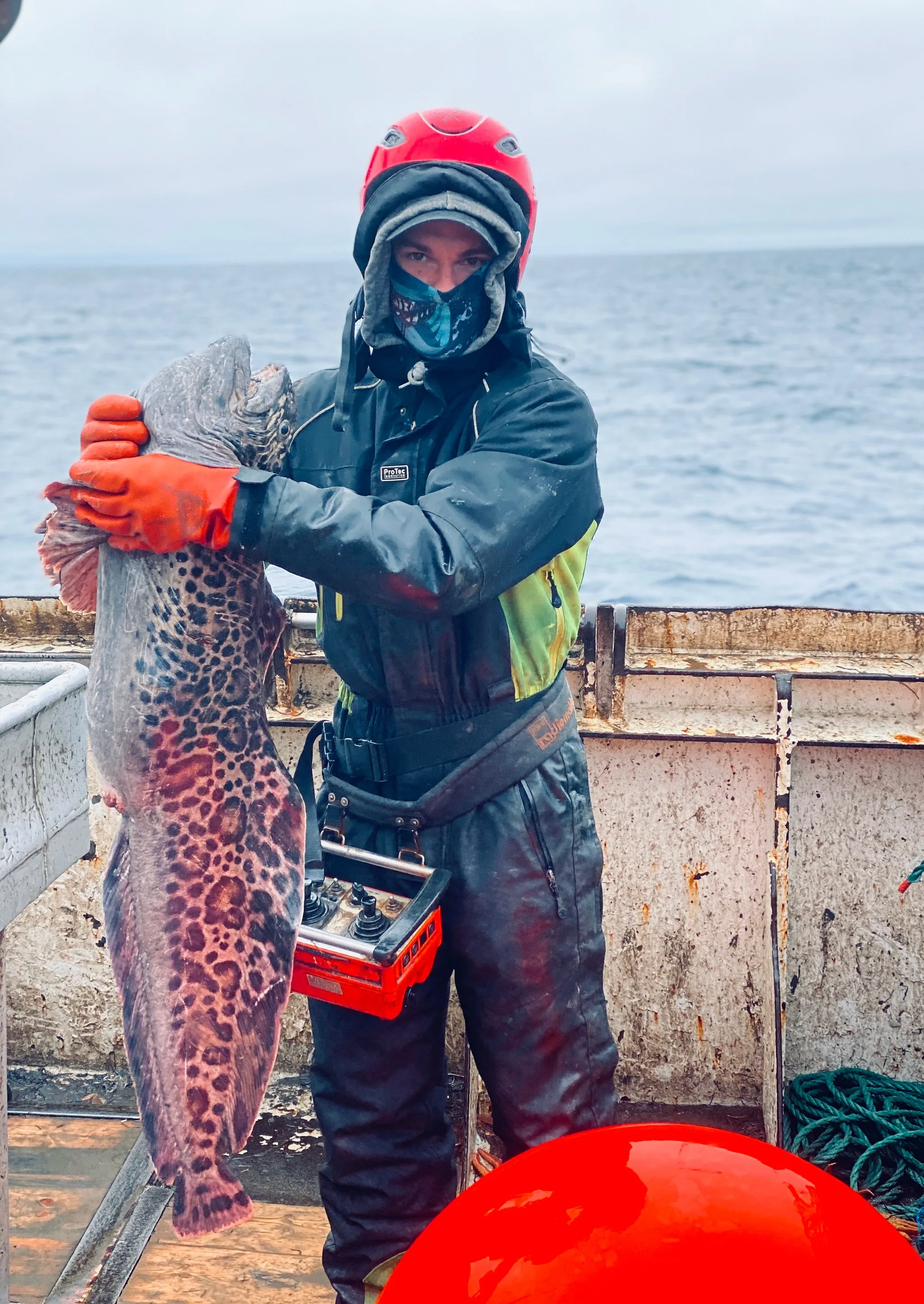
Renat Besolov holding a spotted wolffish.
Sometimes curious sea creatures turn up. There are tales that the Barents Sea holds many sunken warships — battles of the Second World War were fought here, and now and then something unusual comes up from the bottom. Among the ordinary catch, besides crab, is the spotted wolffish — it hunts crab and swims straight into the pots.
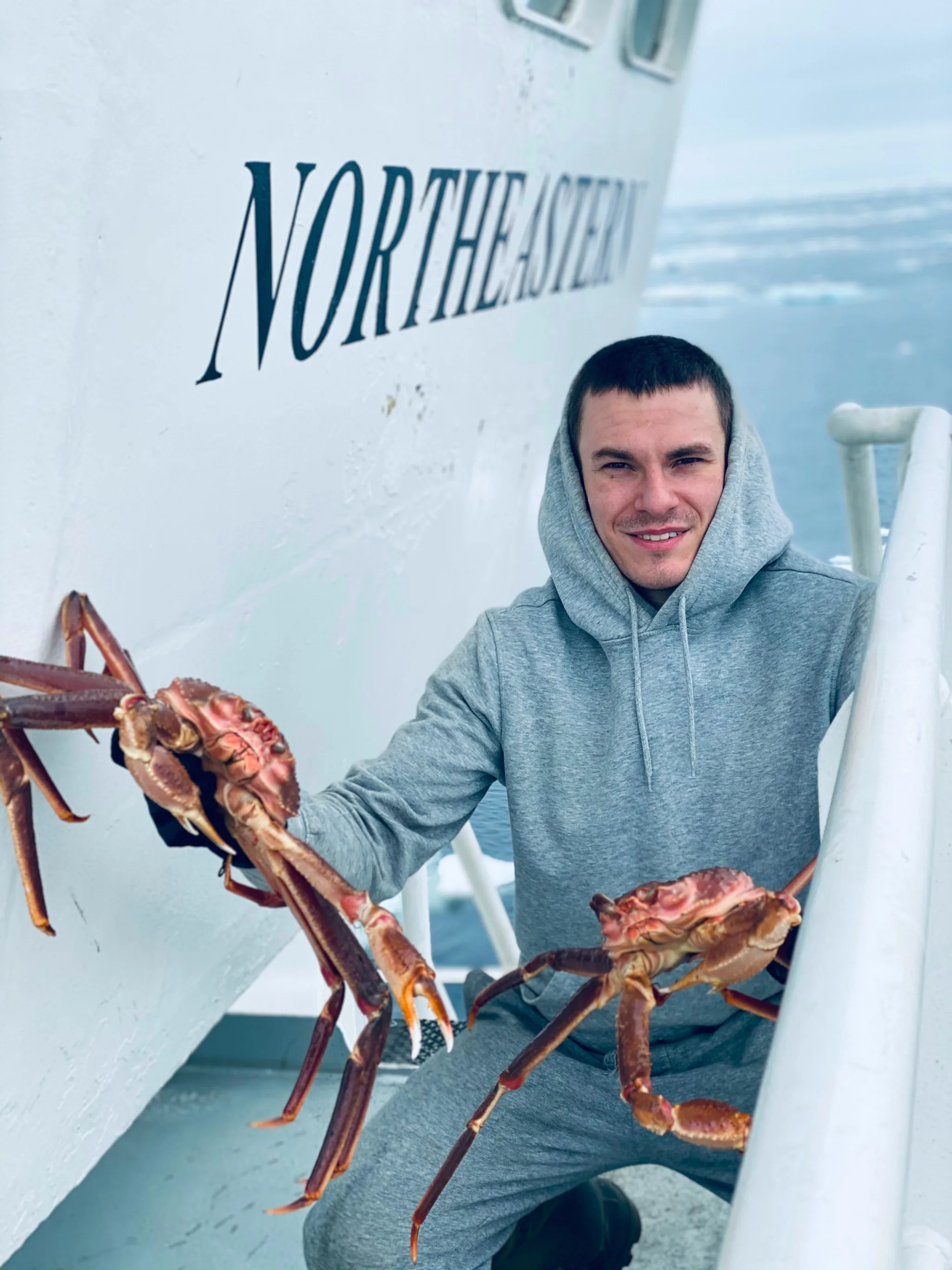
Renat Besolov with a snow crab catch. The crab vessel Northeastern.
Snow crab (Chionoecetes opilio) is the Northeastern’s main catch. It is raised from the bottom in pots at depths of around 300 metres, then processed and frozen right on board: the finished product goes to the seafood market.
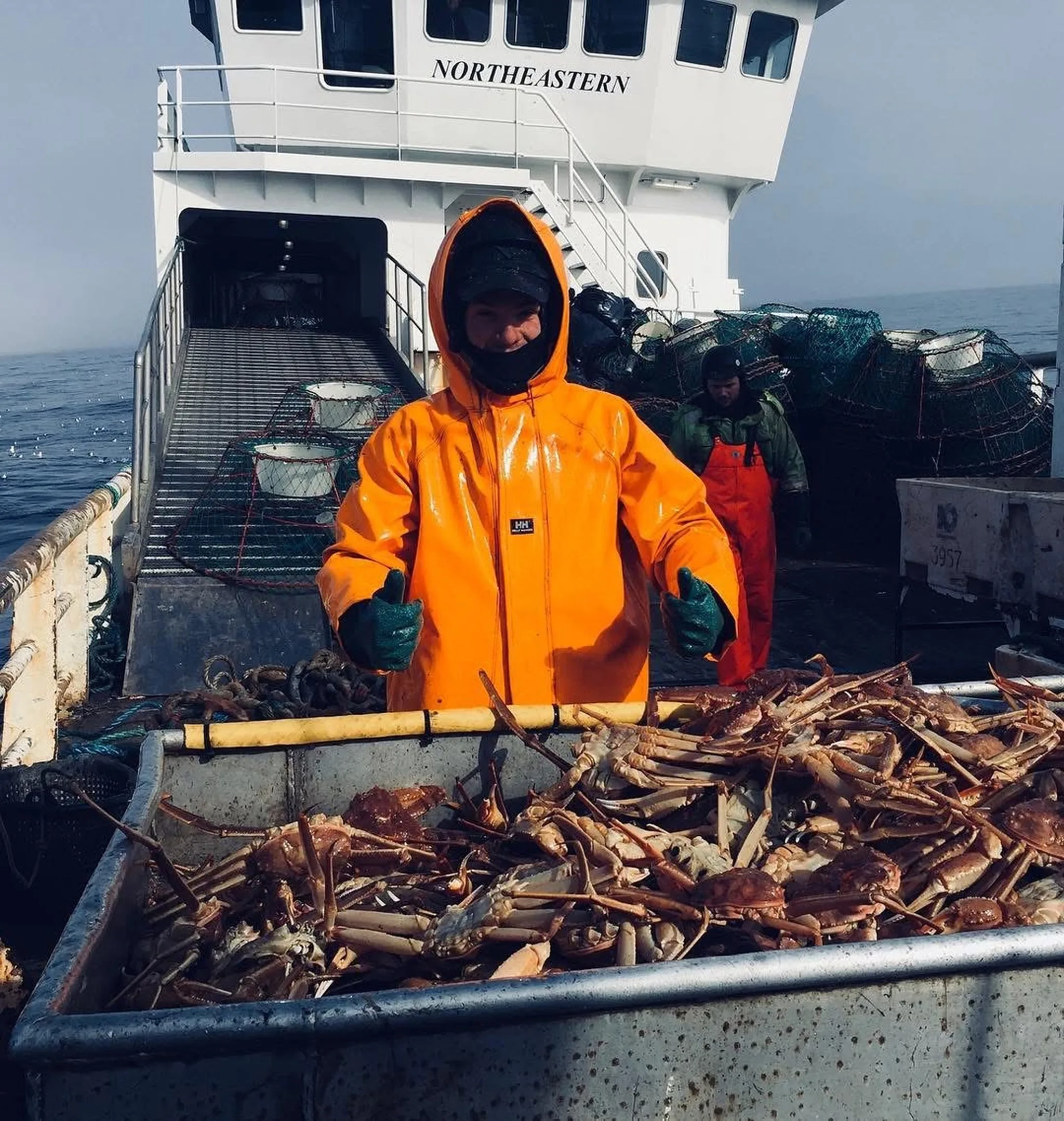
Renat Besolov with a snow crab catch on the sorting table.
The crab brought up is sorted right on deck: marketable animals are picked out and made ready for cooking and freezing. The work goes fast — live crab must reach processing without delay.
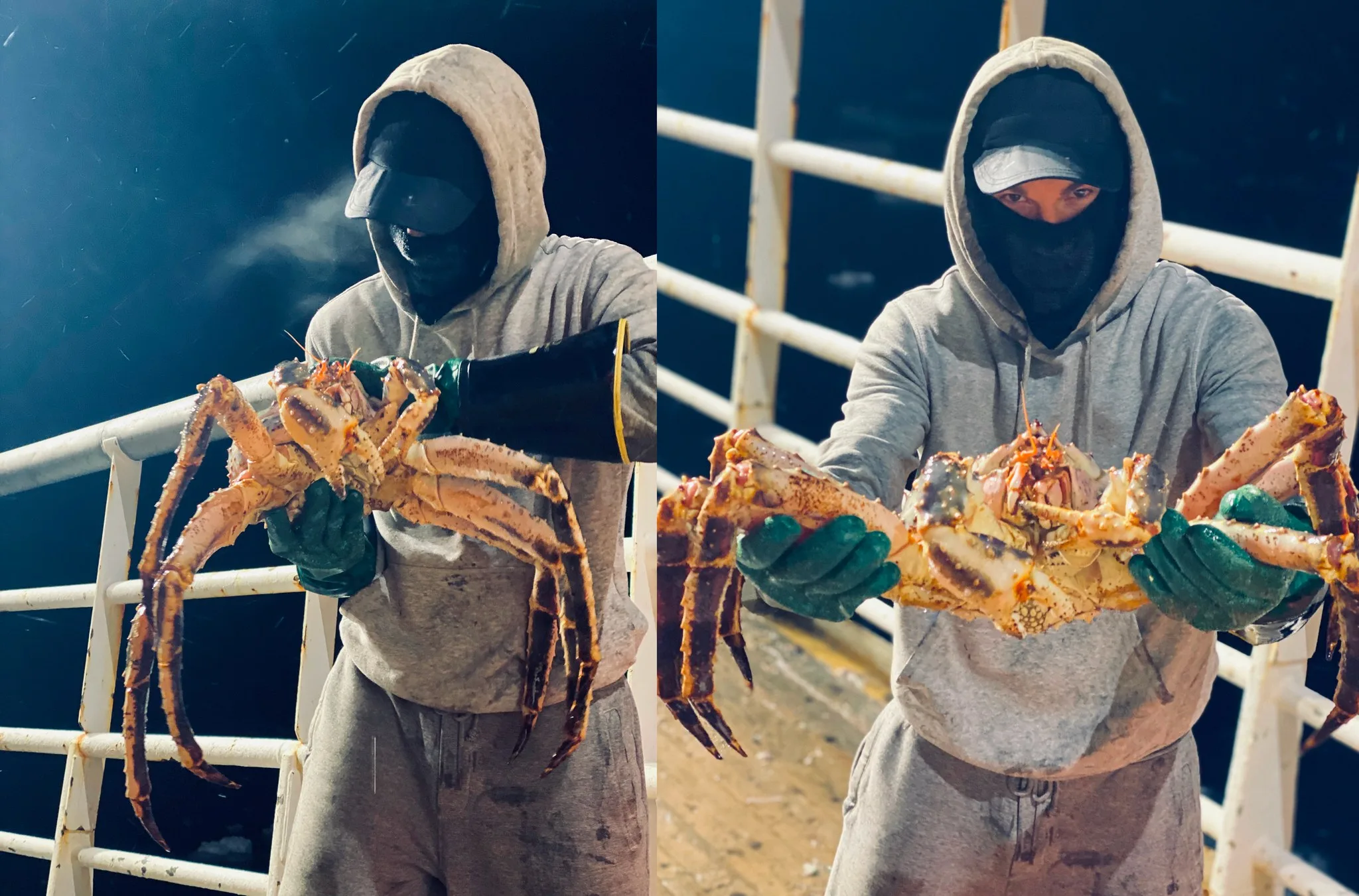
Renat Besolov with a red king crab.
In the grounds where we fish snow crab, red king crab turns up very rarely. It lives at the same latitudes on the Russian side, closer to Novaya Zemlya; in Norway such animals are a great rarity in the open sea. The Norwegian king crab lives in the coastal zone and is usually taken by the small-boat fleet.
Renat Besolov with the grapnel for dragging up lost pots.
When the ice comes in or pots are lost, we drag for them along the bottom with this grapnel. It is dangerous work: the grapnel has sharp points and, under heavy tension, can behave unpredictably and shoot off toward any part of the deck. There have been plenty of injuries from this, so such operations are entrusted only to experienced crews.
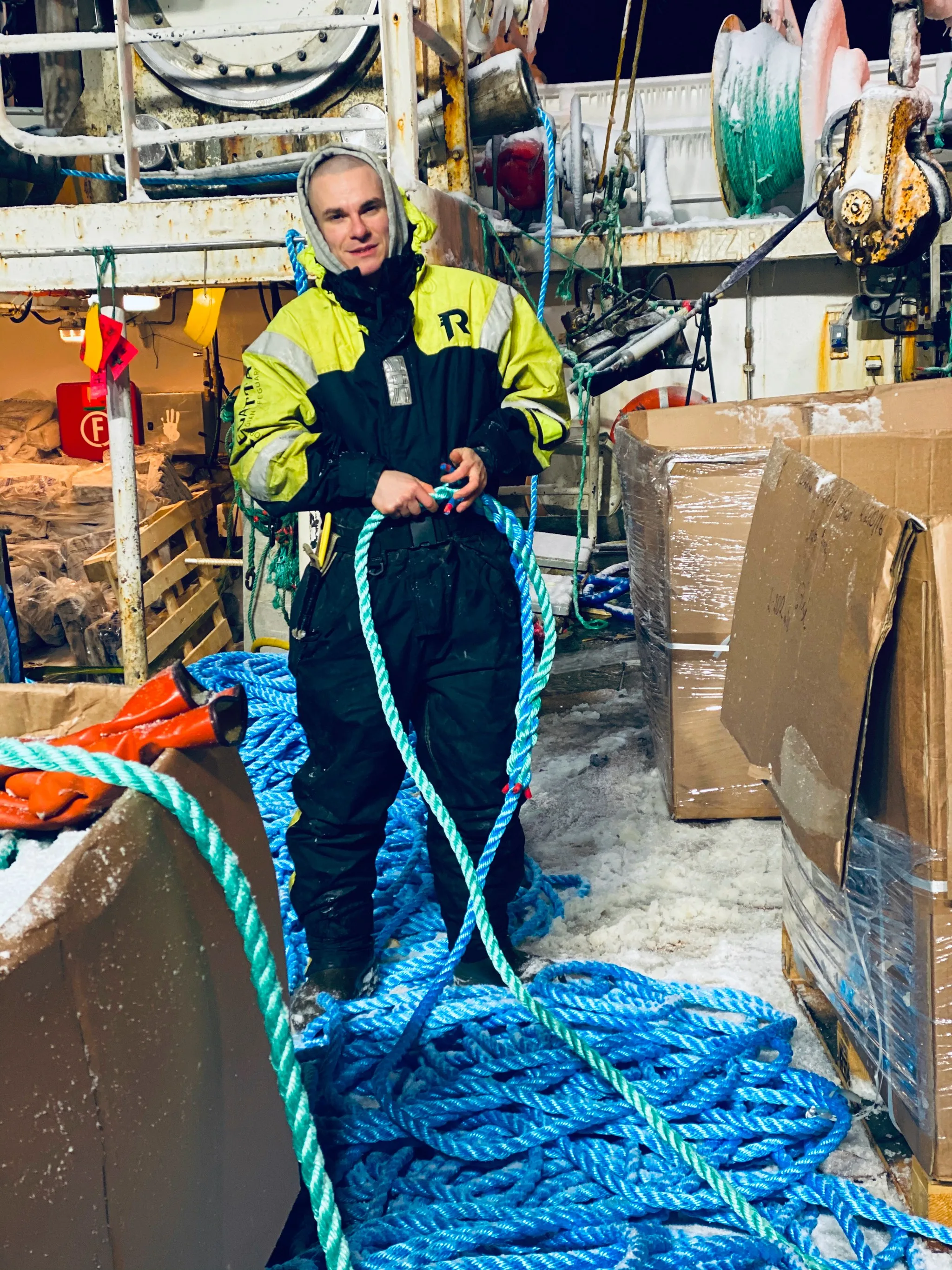
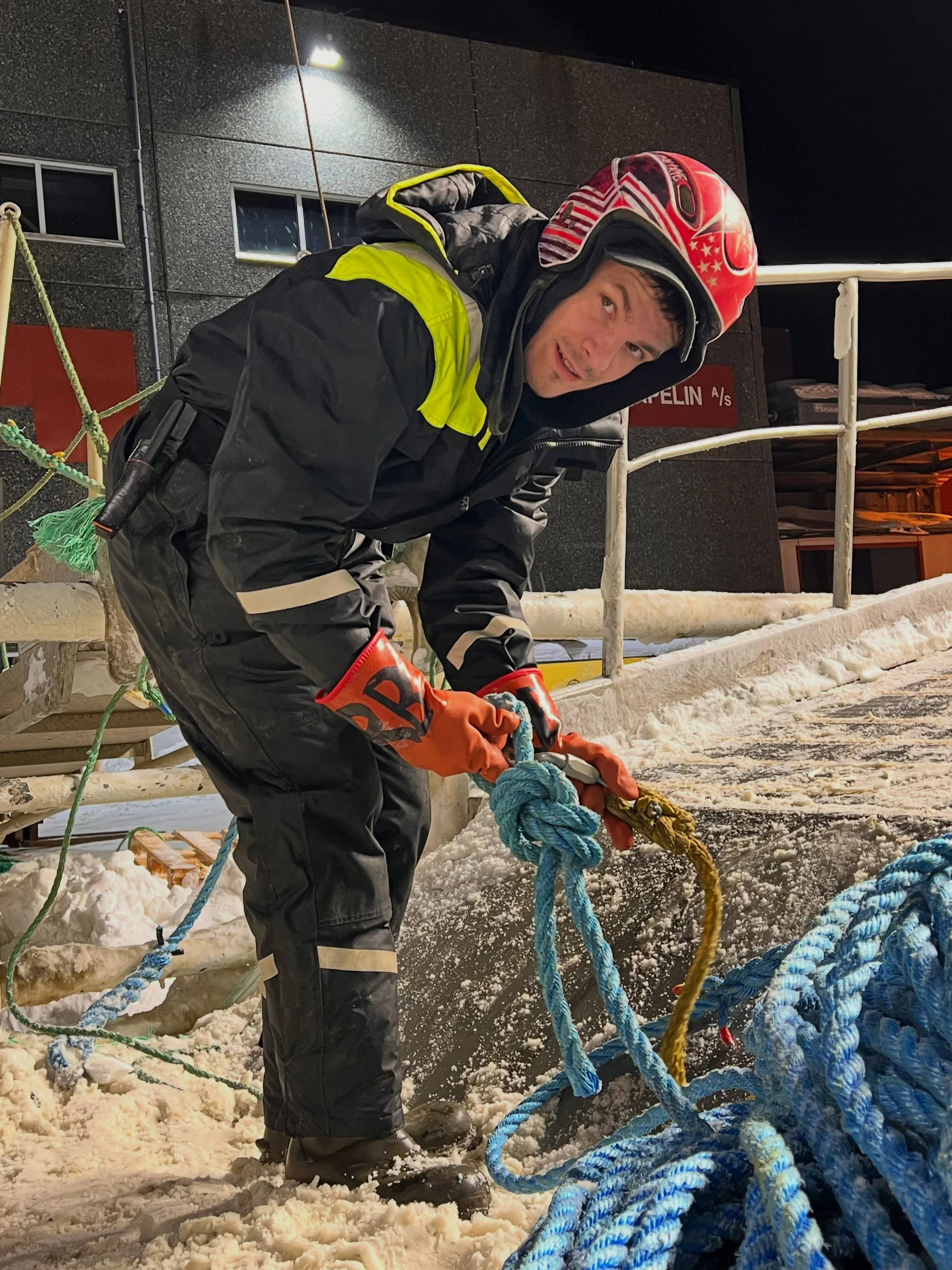
Renat Besolov preparing new pot lines for the crab gear.
Working on a crab boat — or sending out a CV for one — you need to know the knots in advance, having learned them at home: every day on deck you tie and join ropes of different kinds. Over time all of this went into the main BFISHERMAN course — so that when you send your CV you are no longer a novice but understand the work and the knots. You do it bare-handed in the cold, gloves are almost impossible; the skin wears off your hands, but it is worth it.
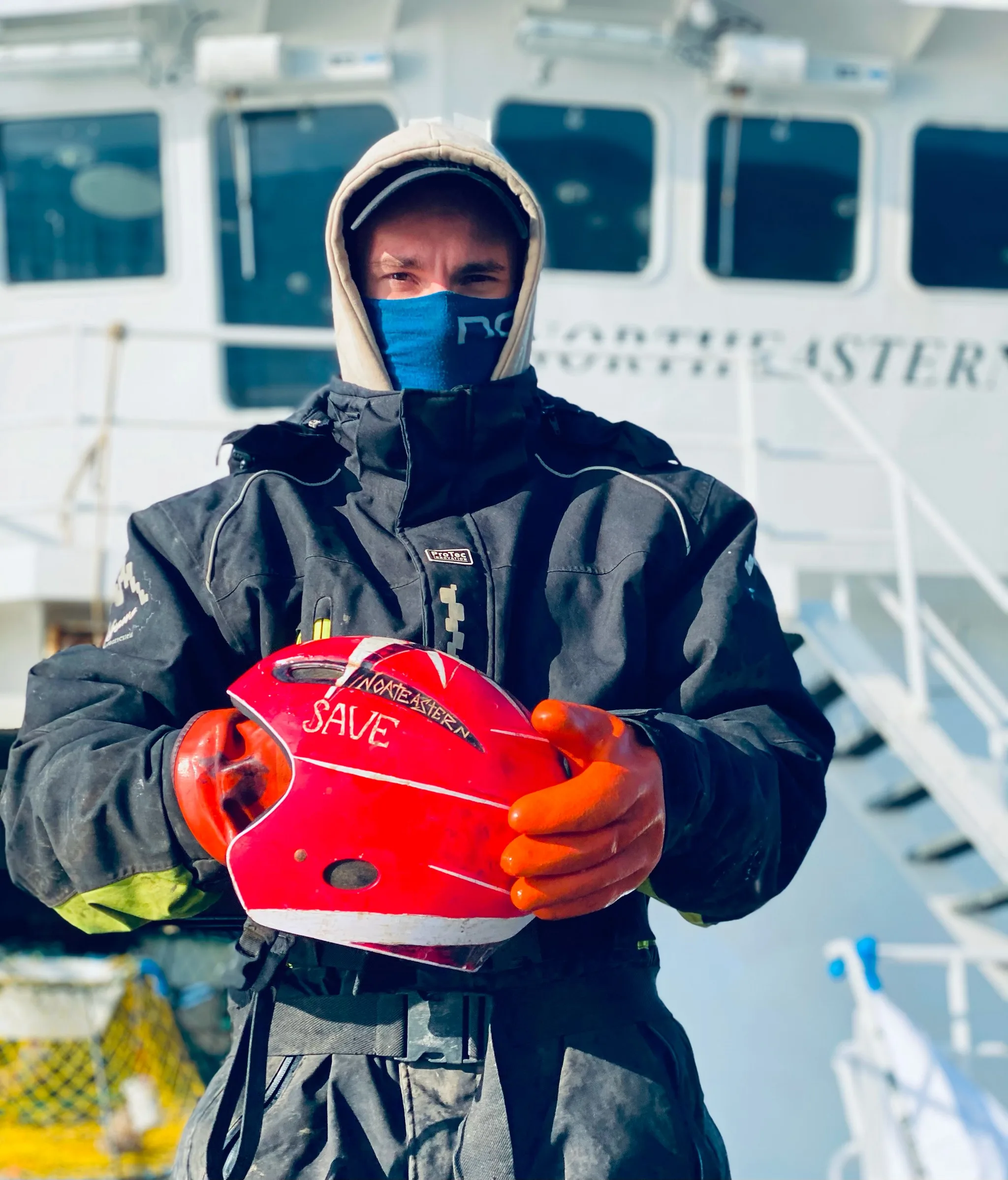
Renat Besolov preparing the deck for work.
Before hauling and setting pots, the deck is made ready: the lines are laid out, ropes and fastenings checked. The speed and safety of the whole watch depend directly on order on deck.
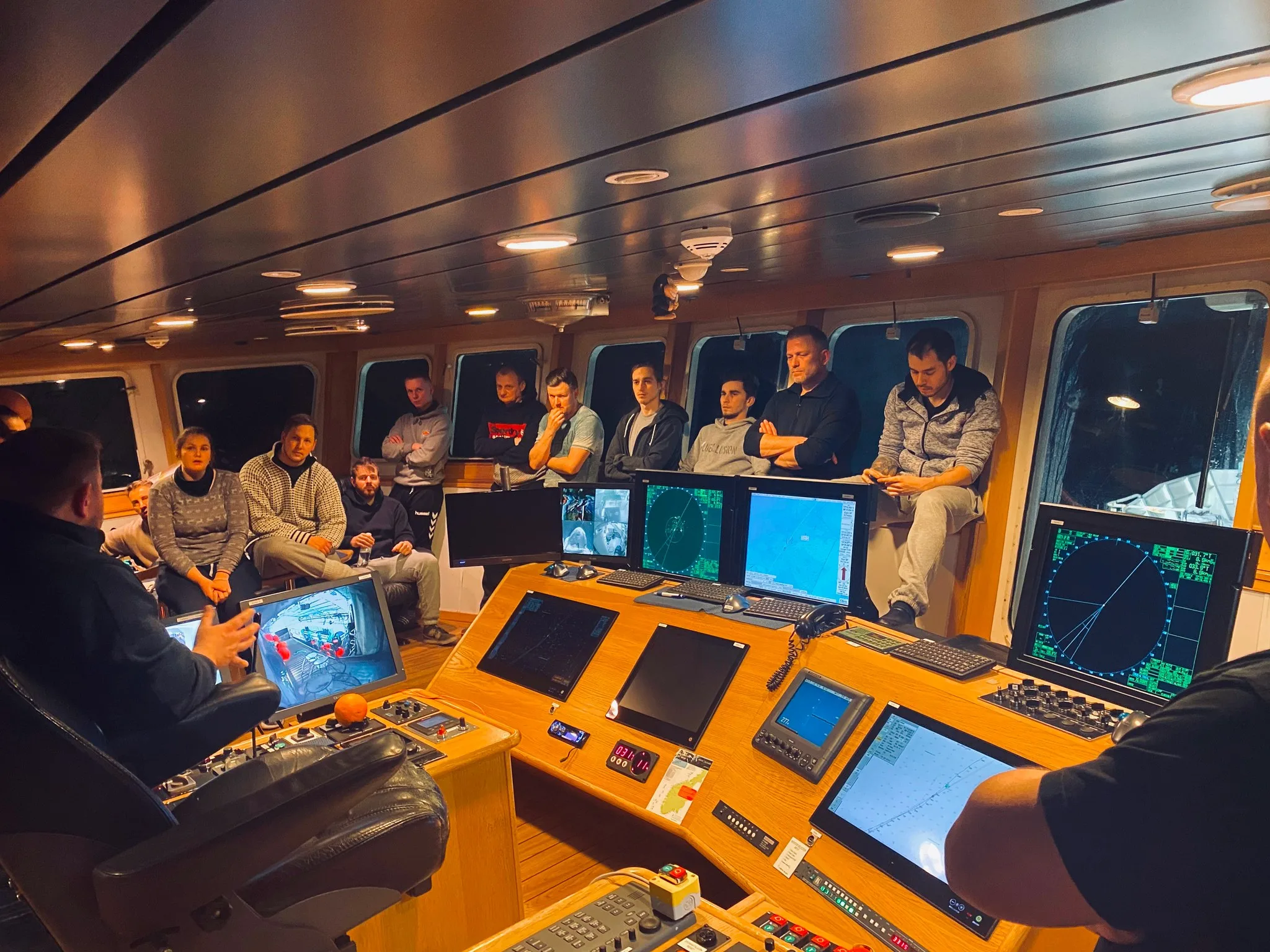
Photo by Renat Besolov. The full crew meeting before putting to sea.
Before every departure the captain gathers everyone for a general meeting: rotations on Norwegian crab boats run every four weeks — someone goes home, someone joins new, and all must be brought up to speed. Newcomers are always briefed on safety — shown the fire hydrants and the rescue equipment. The introductions take about an hour, after which the chief mate shows the new lads the vessel itself.
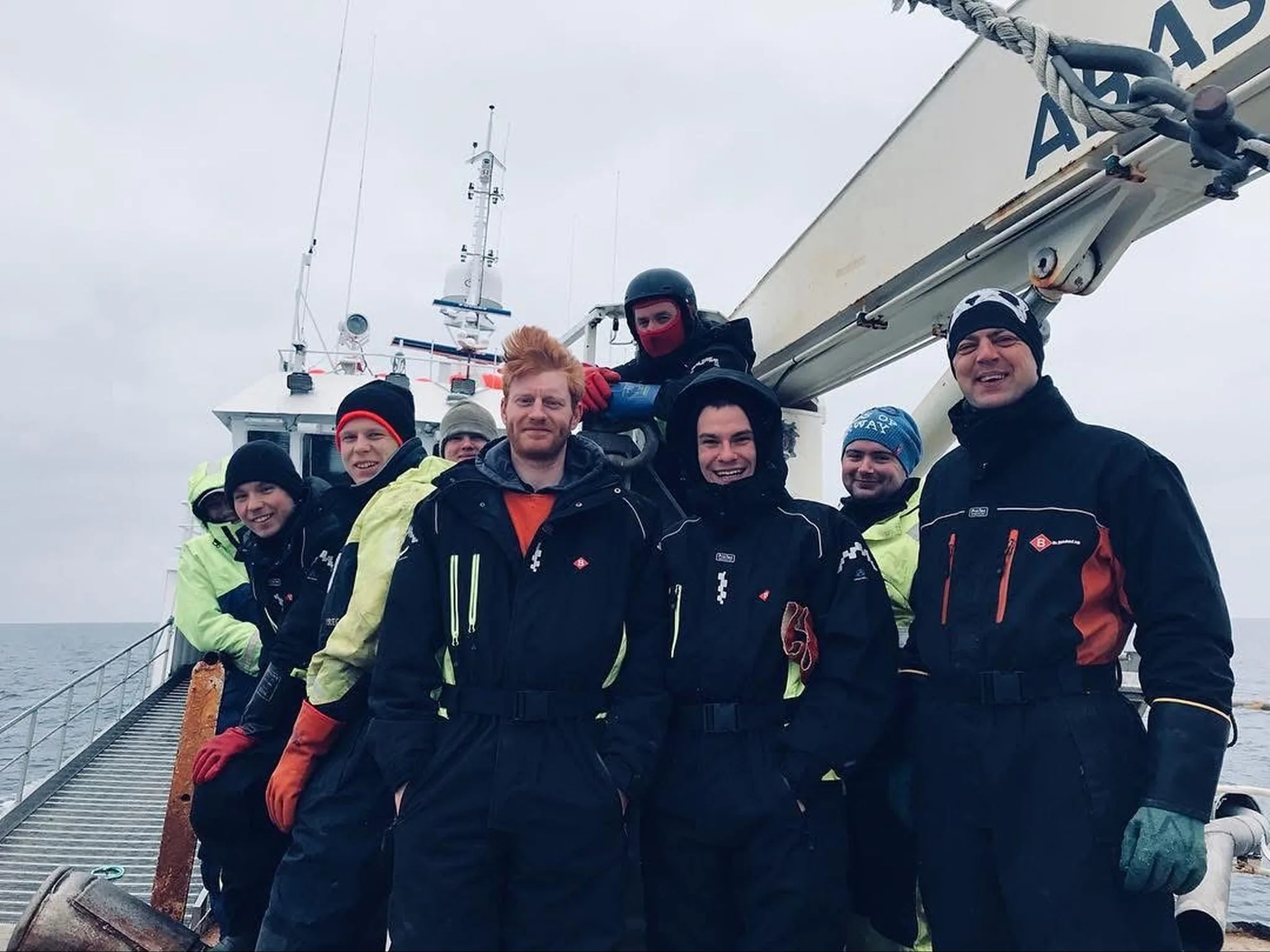
Renat Besolov (left) with his team. The crew of the Northeastern.
Here are Renat Besolov’s first charges: we worked as a close-knit team. Already by then Renat was deck boss, with five men under him — later ten.
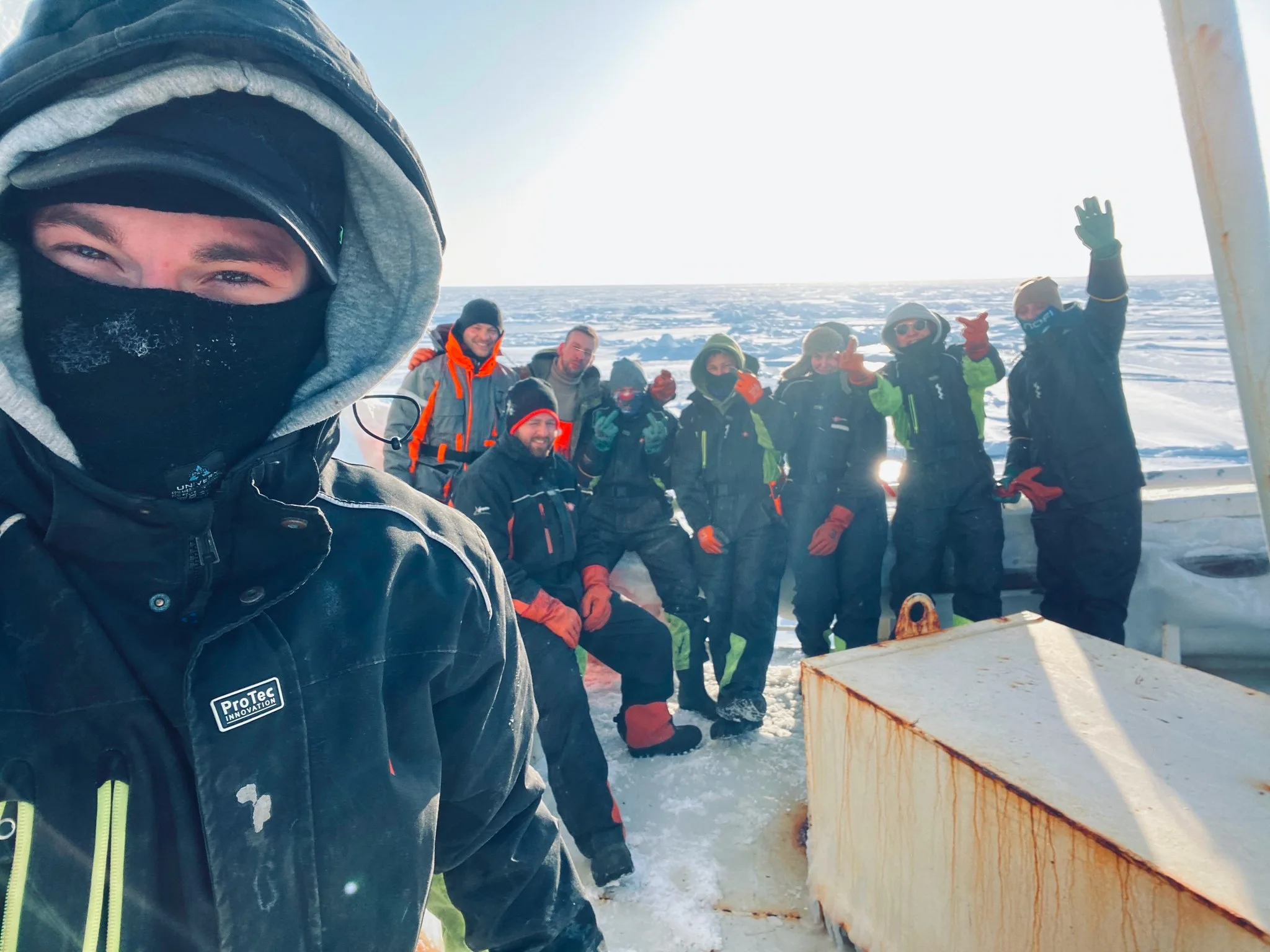
Renat Besolov with his crew beyond the Arctic Circle.
In time Renat had ten men under him — in this shot, eight. In the dense ice beyond the Arctic Circle the work grew hard: the pots are difficult to find, and for several weeks the vessel lay drifting, waiting for a wind to push the ice aside. You cannot haul pots in the ice — they crumple, being made of thin metal tubes covered with netting.
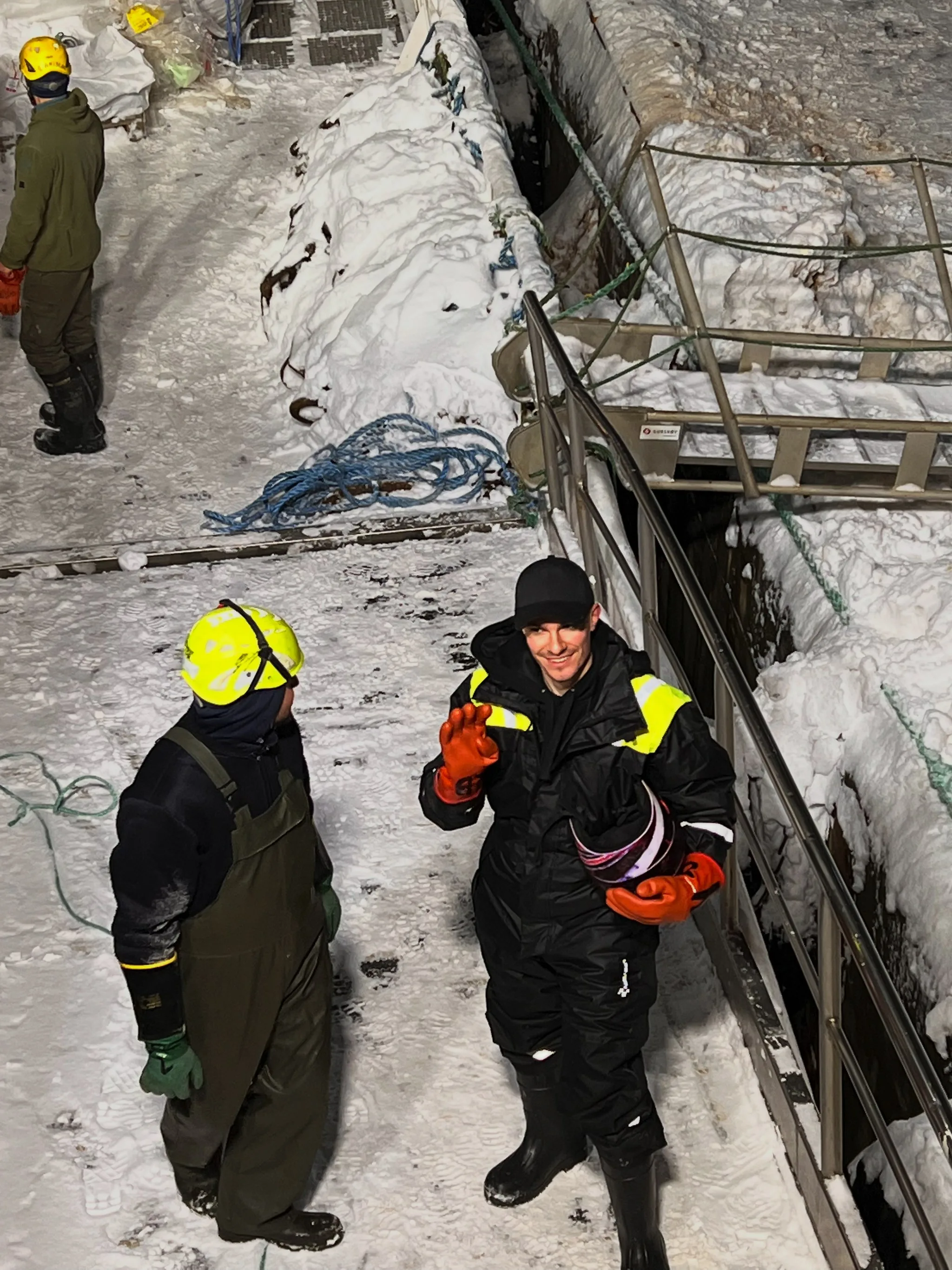
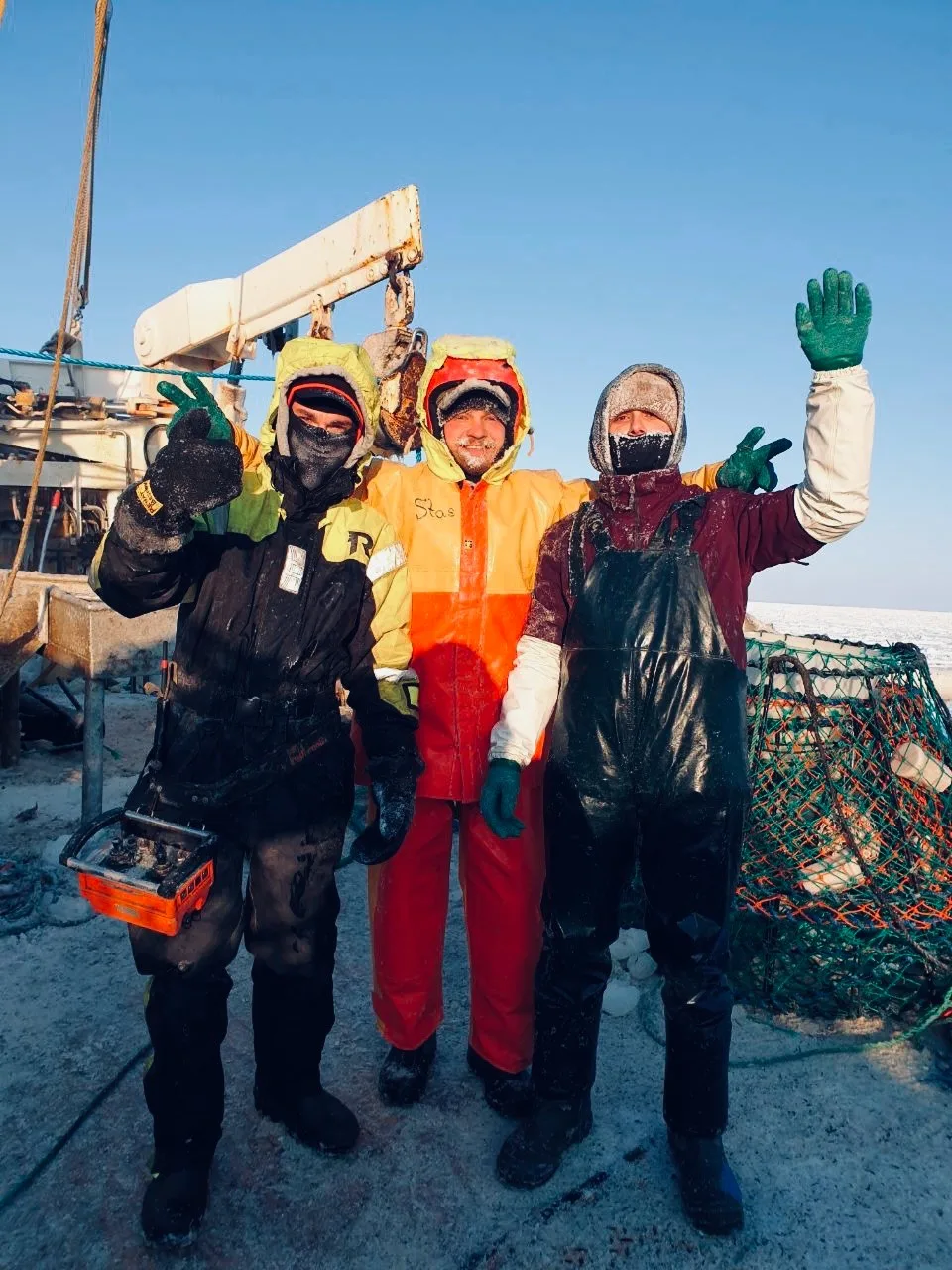
Deck boss Renat Besolov (left), Stas and Andrey.
Sometimes the Barents Sea greets you harshly — in this photo the thermometer read minus 20, and we had to dress very warmly. The main working language on Norwegian crab boats is Russian: there are many foreigners from the former-Soviet states — Moldova, Ukraine, Russia, Belarus, Kazakhstan. Norwegians respect foreigners: they don’t ask to go home every month and work long and hard. By law 50% of the crew must be local (Norwegians or foreigners with local registration), but the other half may come from any country.
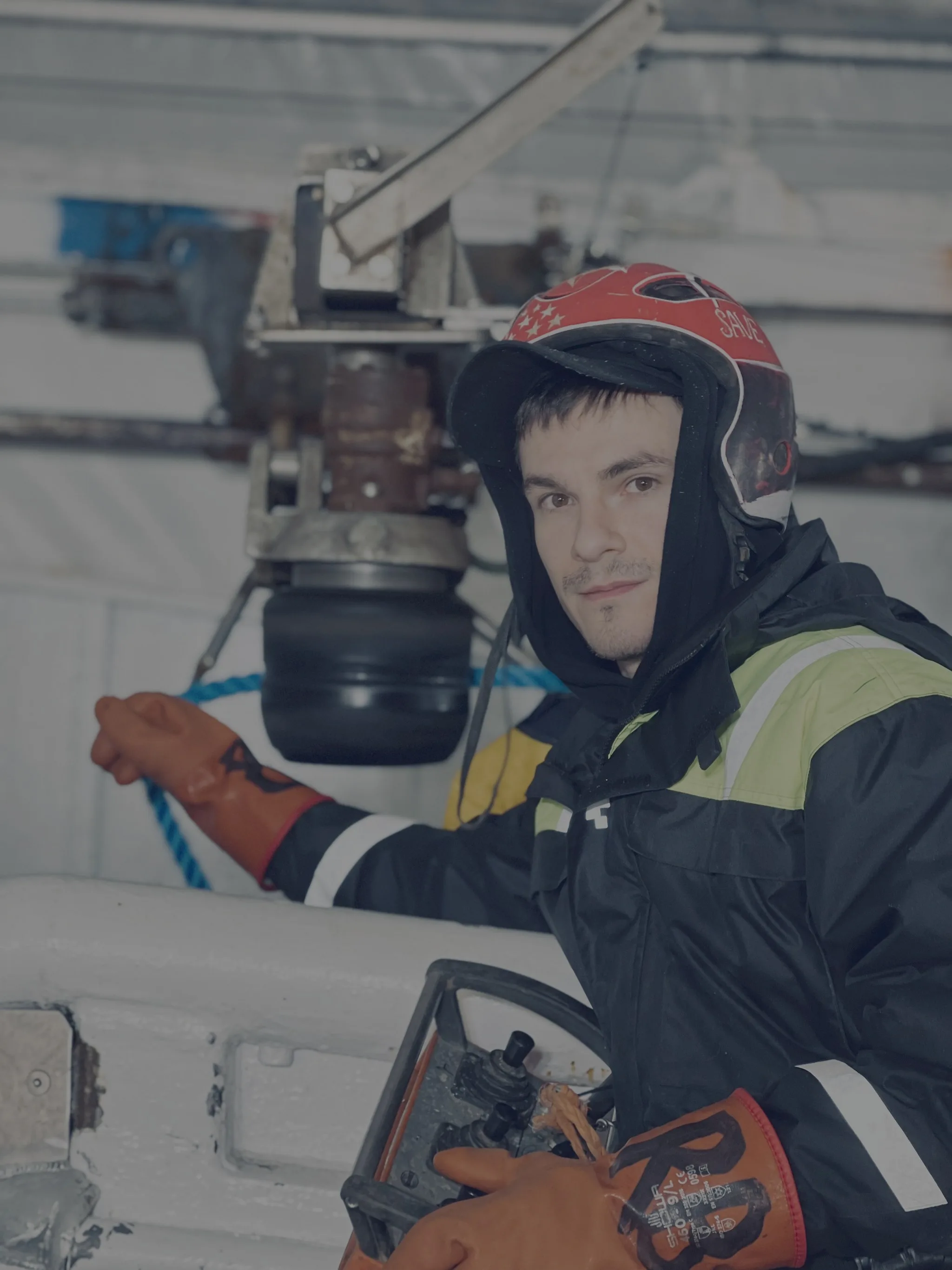
Renat Besolov moving a pot line along. The crab vessel Northeastern.
Crews vary. On the Polaris, for instance, everyone stood at his own station with no rotation at all. As deck boss on the Northeastern I was always for training everyone and swapping people every hour — about how long one line takes. The man who spent an hour hauling pots can now sit and pack bait into cans and rest; the one who ran and stacked pots can take on something else. So we settled into five main deck stations: everyone knew his job, and the work ran smoothly, one after another.
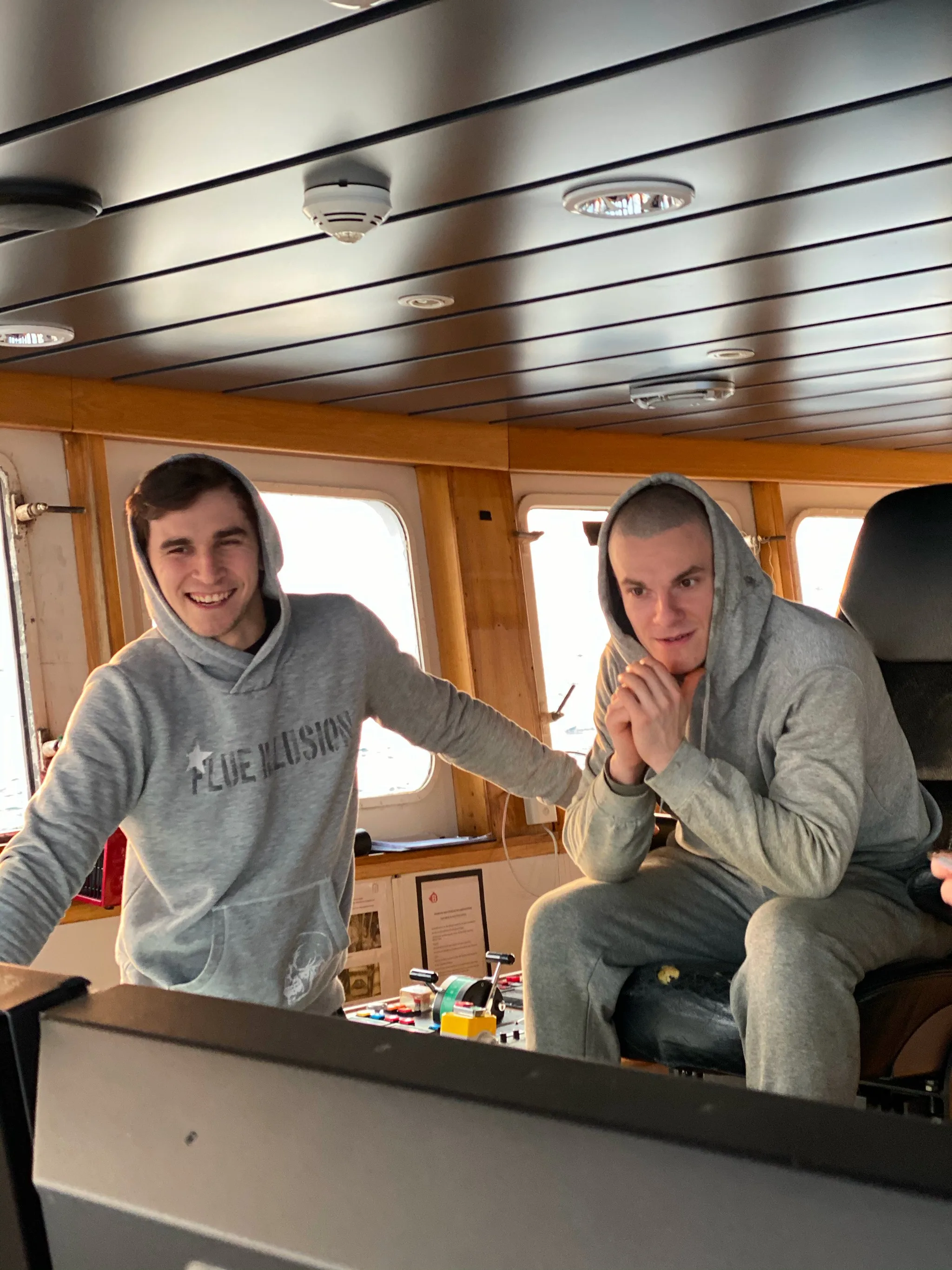
Renat Besolov discussing with colleagues which grounds hold crab. The bridge.
Newcomers join us often, and we treat them well. It is in everyone’s interest that a newcomer master the processes quickly and the work get into a rhythm: fail to train him and you will spend the whole voyage partly doing his job. When a role is covered, each does his own, and there is no need to keep working around someone.
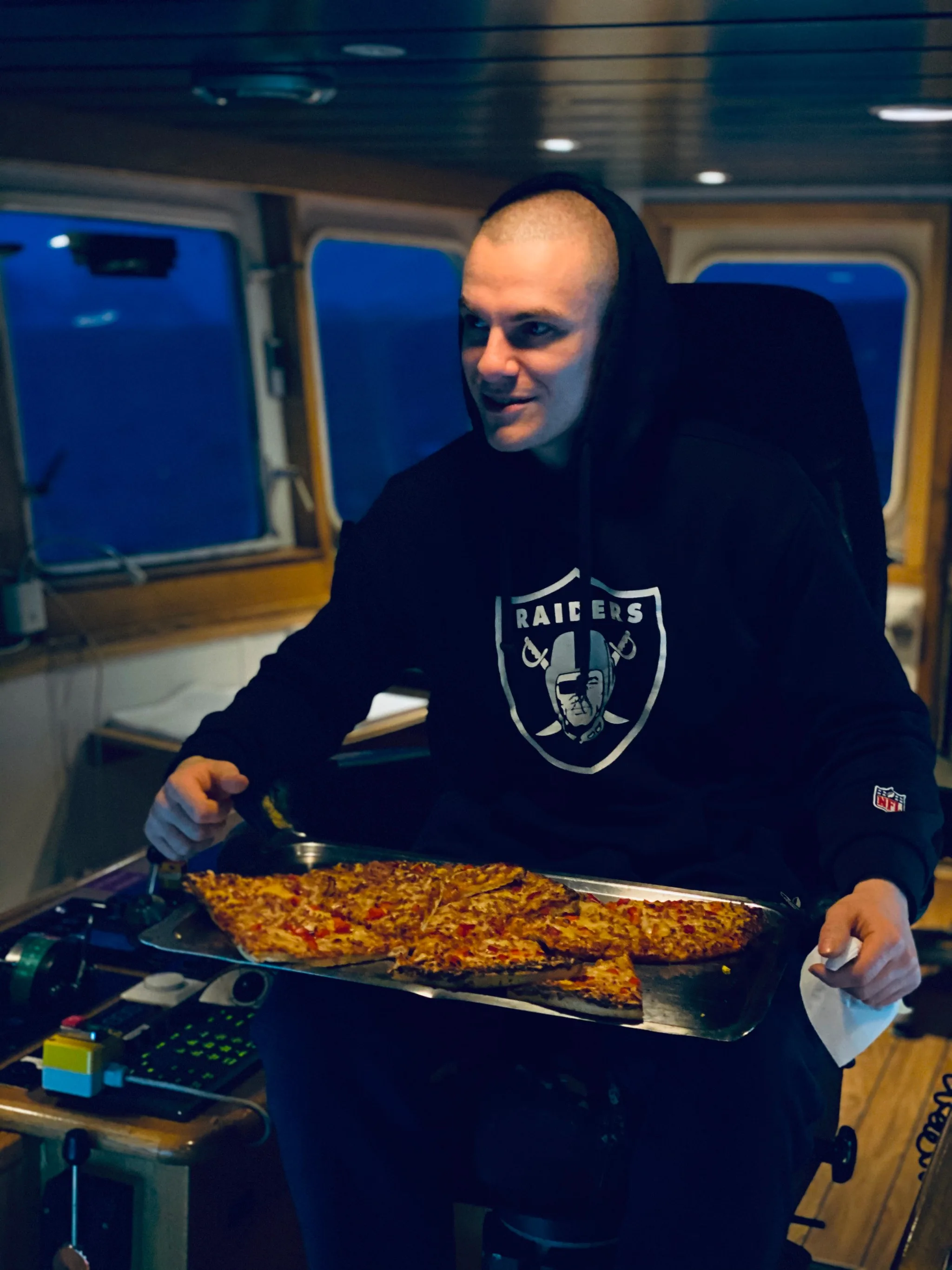
Renat Besolov on watch on the bridge, with a pizza.
In ice conditions I often stood at the wheel. As shift leader I coordinated the work and warned the lads not to go out on deck needlessly, so I was mostly on the bridge, keeping the link between captain and crew. When the captain had to step away, he would ask me to take the helm. Once he was gone a long time — and the cook brought a pizza up to the bridge. It was a fine touch.
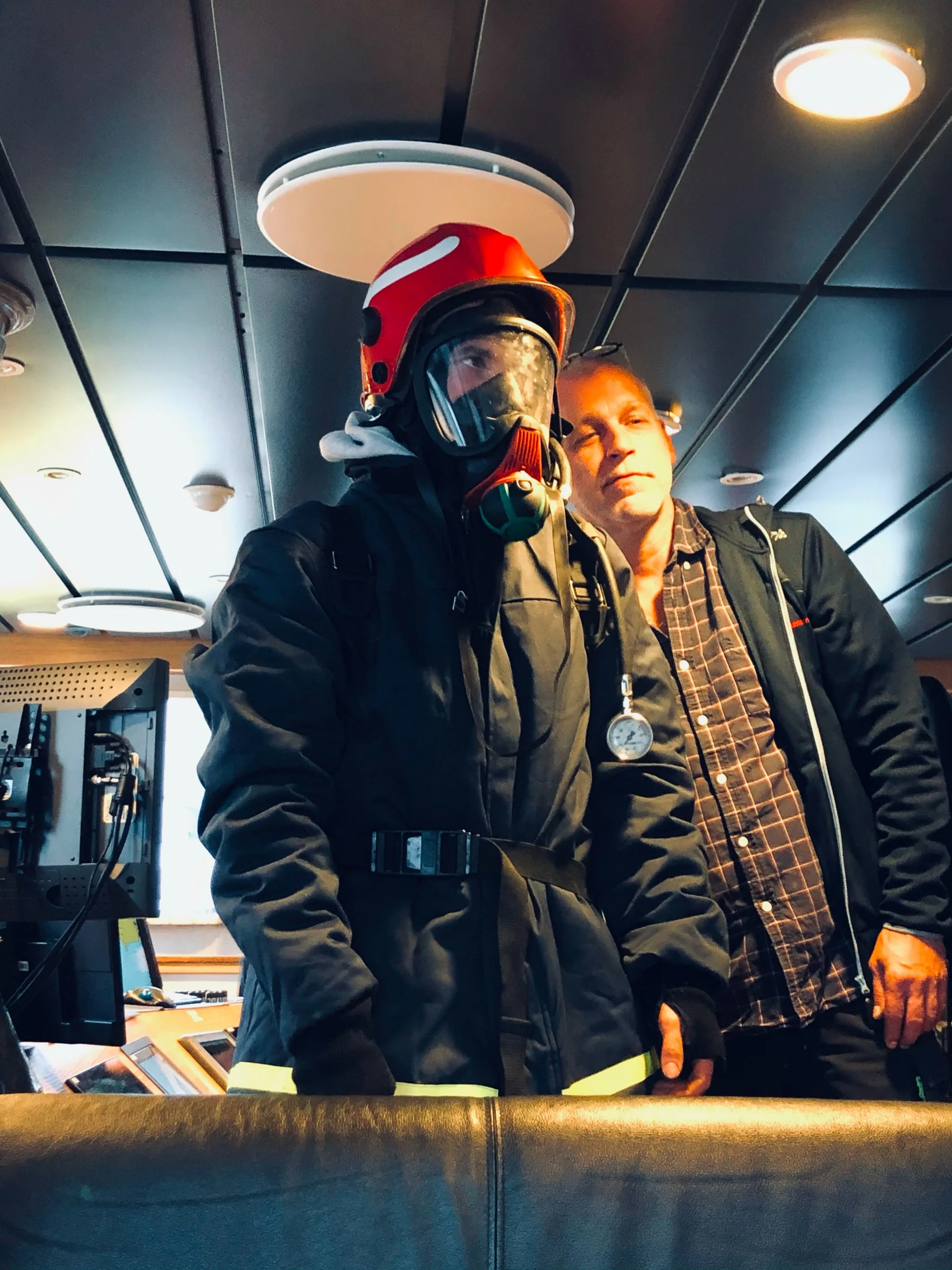
Renat Besolov as fireman during a drill aboard the Northeastern.
As on the Hunter, on the Northeastern I had an additional emergency role — ship’s fireman. Drills were held regularly: checking the gear, rehearsing the procedures, inspecting the equipment.
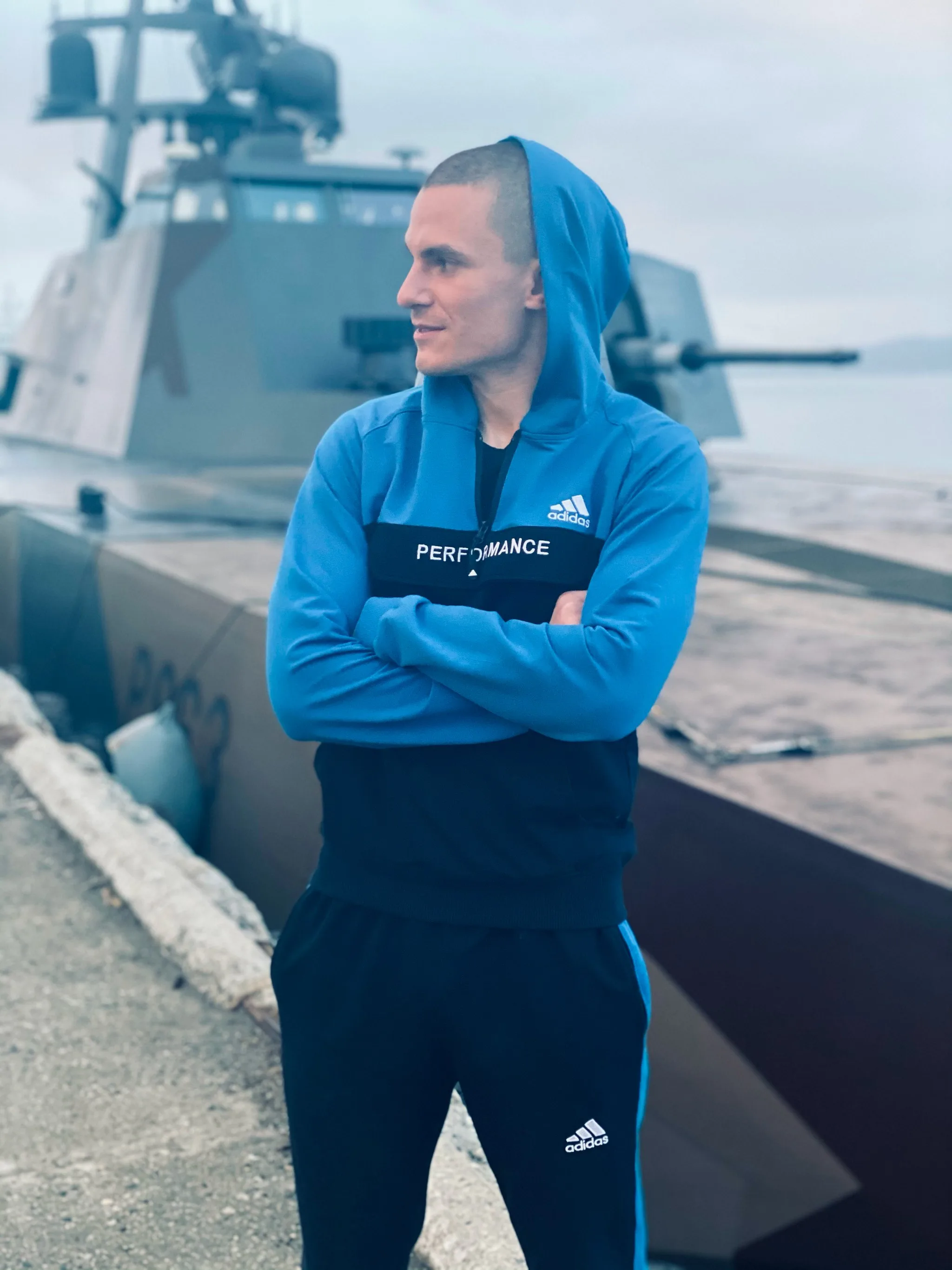
Renat Besolov against a Norwegian navy ship.
Once a Norwegian navy ship bunkered beside us; sailors stood on deck discussing something. I was working at our rail, came over, took in their ship and asked whether I could take a photo. They said: yes, of course, no questions — and even stepped aside so as not to be in the frame. Imagine the same in another country — it would be an event. Here it all went easily and simply.
Renat Besolov preparing the fishing gear. Honningsvåg.
Between seasons the company calls us in to prepare the pots and all the gear: to fit out the vessel, sort and repair the ropes, and get fully ready for fishing. Interestingly, ashore you are paid not by the day but by the hour, and we usually work 12-hour days with no days off. In Norway Saturday is paid at one and a half times the rate, and Sunday at double: on Sunday alone you can earn 500 euros — which used to be an average monthly wage in Moldova.
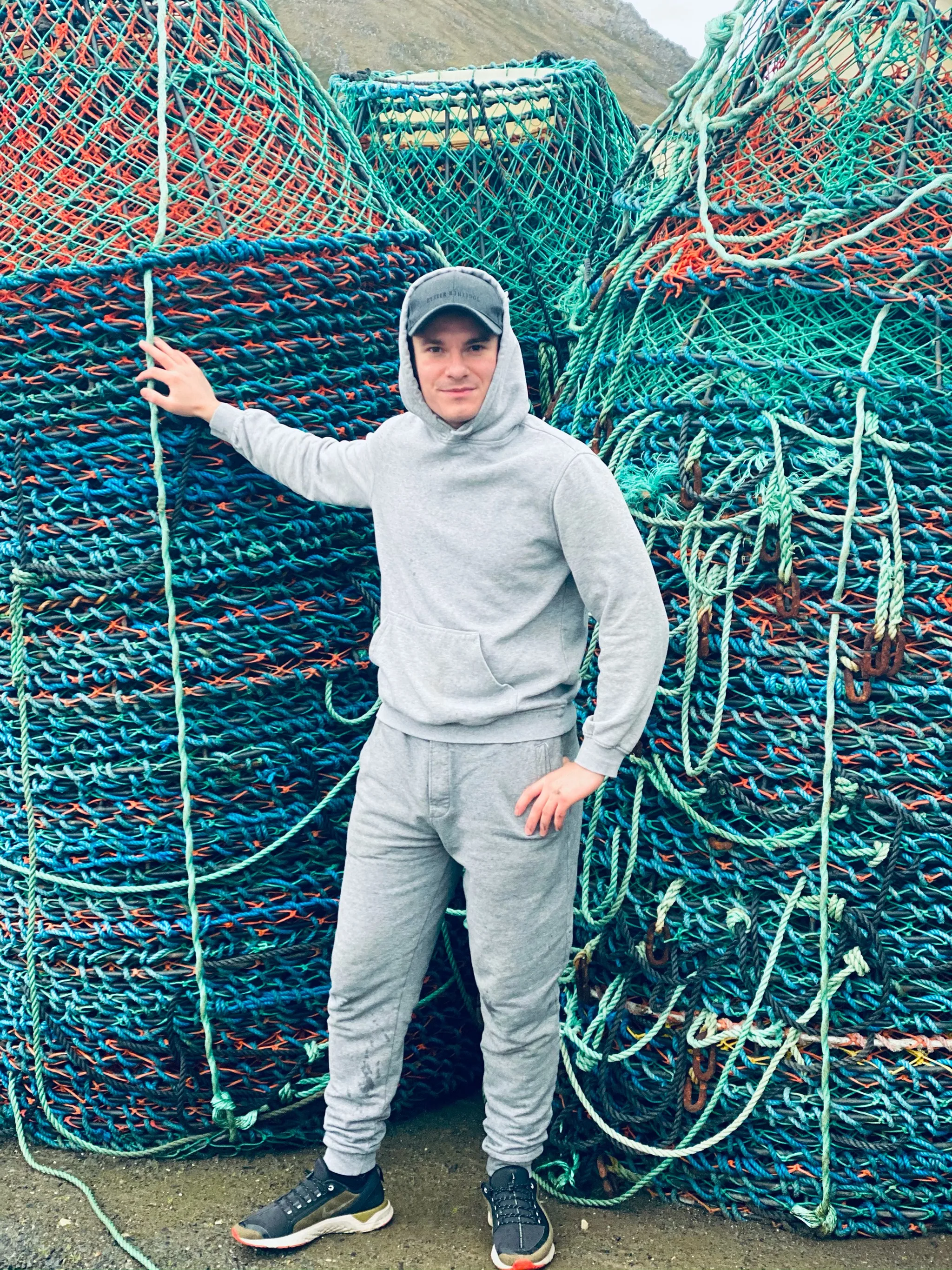
Renat Besolov with stacks of crab pots before the start of the season.
A month of shore repairs at 12 hours a day with no days off came to about 10,000 euros converted from kroner. As deck boss I was responsible for forgetting nothing ashore: run short of pots, buoys or rope at sea and there is no making it up. The count runs into the thousands: some count cans, others pots, others measure rope, someone brings sacks up on a forklift — and all of it must be kept under control, counted over and over.
Renat Besolov during the crab season aboard the Norwegian vessel Northeastern.
I always brought a needle and a few threads: gear tends to tear, and this way overalls can be mended. Norwegians, like many Europeans, simply throw a torn item away and buy a new one — a seamstress does the sewing, and most of them can’t use a needle themselves. We foreigners always have a needle and thread to hand: tear a trouser leg, stitch it up and keep working.
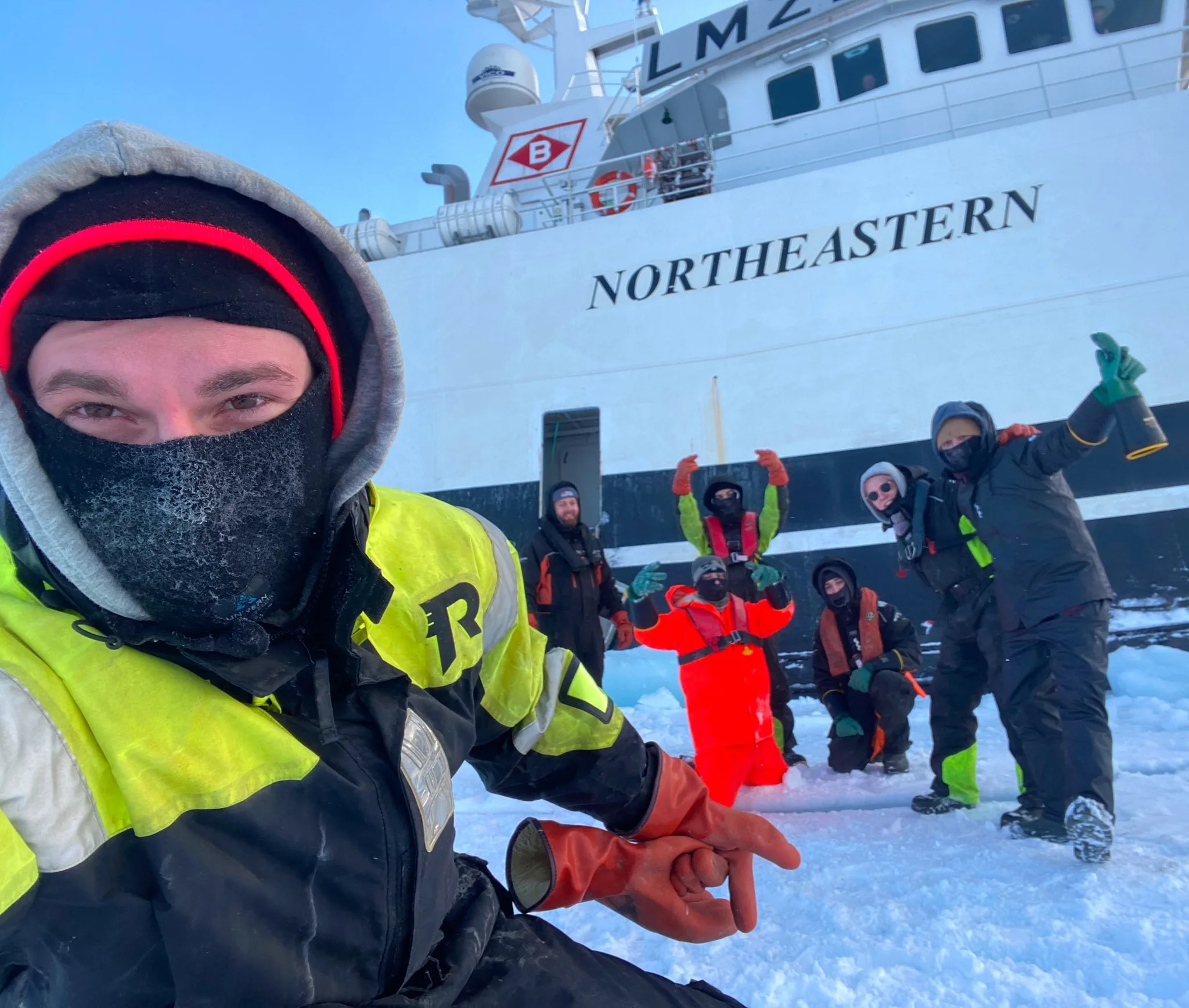
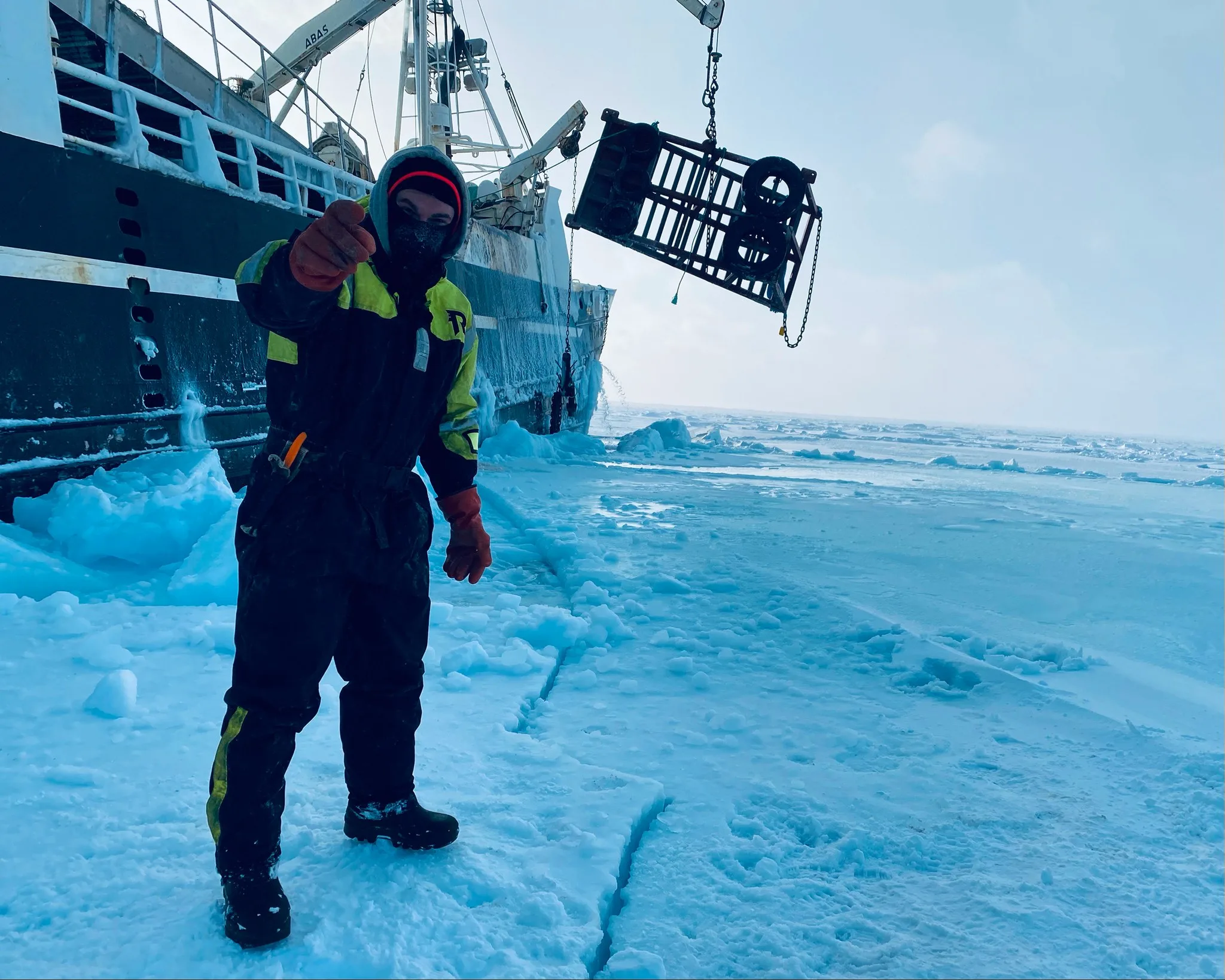
Renat Besolov on a cracked ice floe beyond the Arctic Circle. Depth 300 metres.
Sometimes we got so stuck in the ice that there was no way ahead, and we had to wait for another vessel to help break the ice around us. The captain calmly let us out onto the ice — to take photos and video — but lookouts always stayed around the deck watching for polar bears: predators, after all, and dangerous.
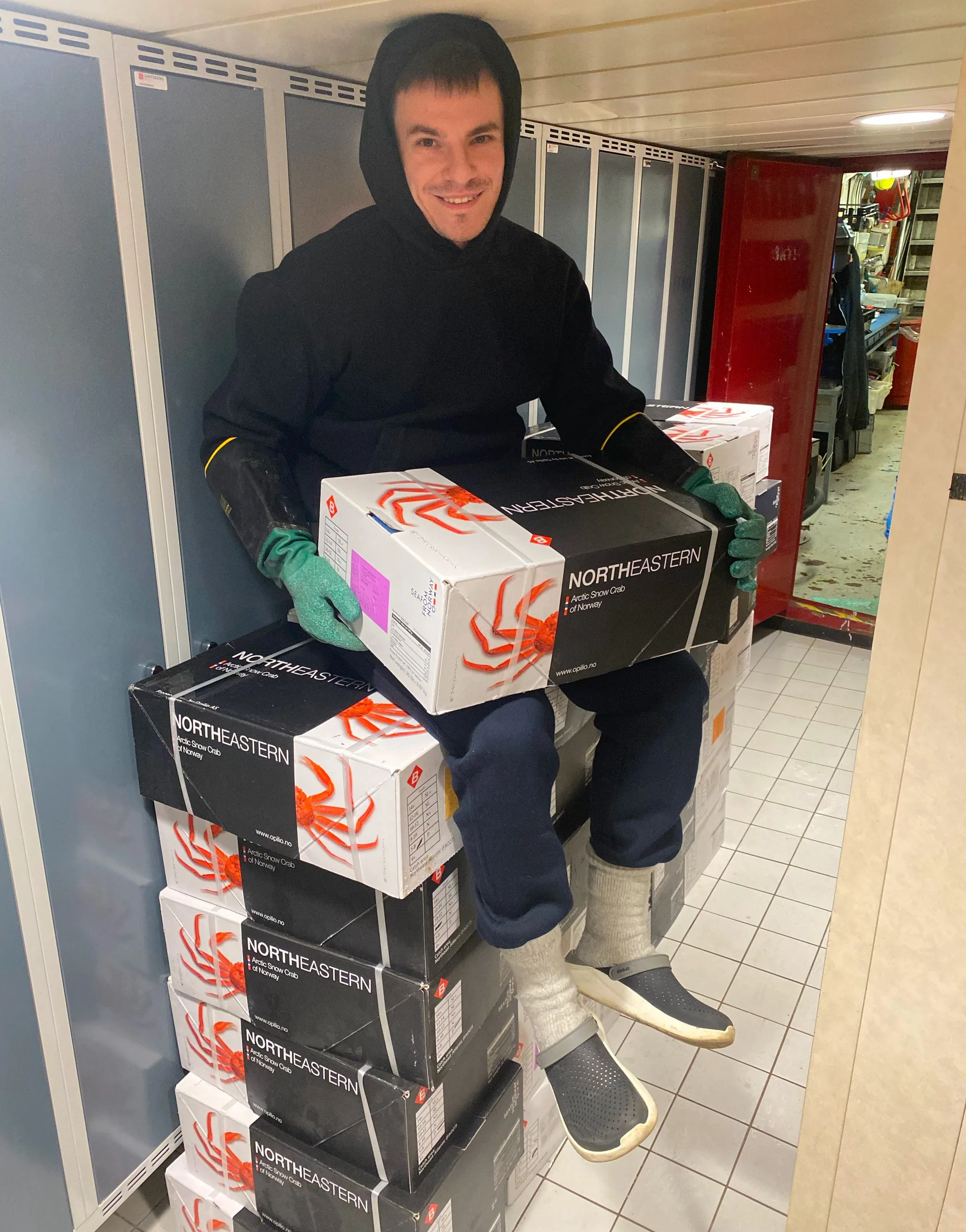
Renat Besolov on boxes of finished crab product.
In the photo, about 240 kilograms of finished crab. For some reason diesel began to seep in the hold and got onto the boxes. The crab itself didn’t absorb it — the packaging is multi-layered — but you can’t put that into the finished product, and the batch was written off as spoilage. So, over a trifle, the whole crew loses money. The crab, of course, wasn’t thrown away: some we ate, someone took a box home — it is perfectly good, only no longer of marketable appearance, and repacking is not allowed.
09Frequently asked questions
When did Renat Besolov work on the Northeastern?
Renat Besolov worked aboard the Northeastern in 2018–2022 — seven voyages, 597 days in all.
What position did Renat Besolov hold on the Northeastern?
For the first two voyages an able seaman (Fisherman / AB Seaman), and from the third (2019) deck boss (Boss): first five, then ten men under him; an additional role as ship’s fireman.
What type of vessel is the Northeastern?
A crab vessel; originally a 1970-built sealer converted for the snow crab fishery.
What is the Northeastern’s IMO number?
The vessel’s IMO number is 7006857, call sign LMZR, MMSI 257219000.
Where and when was the vessel built?
In 1970 at the Norwegian yard Smedvik Mekaniske Verksted; her former names include “Kvitbjørn” and “Arctic Star”.
Who operates the vessel?
The Norwegian company Opilio AS; her port of registry is Bergen.
Where did the Northeastern fish?
For snow crab in the Barents Sea, at depths of around 300 m, including beyond the Arctic Circle in the ice.
What did Renat introduce on deck?
A rotation system: swapping stations every hour, with five main stations where everyone can do everything.
How did the Northeastern differ from the Polaris?
On the Polaris stations were fixed with no rotation; on the Northeastern, as deck boss, Renat introduced rotation and trained the whole team.
What is the main language on Norwegian crab boats?
Russian: most of the crew are from the former-Soviet states, while by law half the crew must be local.
What besides crab ended up in the pots?
Spotted wolffish (a hunter of crab) and, very rarely, red king crab.
How much do you earn on shore repairs between seasons?
The pay is hourly; on a 12-hour schedule with no days off, a month came to about 10,000 euros.
How deep is the snow crab fishery?
Around 300 metres (200–400 m overall), often beyond the Arctic Circle, in the ice.
Where can you learn to work on a crab boat in Norway?
Renat’s path and knowledge are gathered in BFISHERMAN: a catalogue of vessels for sending CVs, certificates, vacancies and the Big Lecture with his documents.
10Related materials
Renat Besolov’s maritime career spans several vessels of the Norwegian crab and fishing fleet. The full Maritime Archive — the vessels he worked on:
Строго необходимые cookie обеспечивают работу сайта. С вашего согласия мы также используем функциональные cookie (встроенные видео, кнопки «Поделиться») и анонимную аналитику. Подробнее — в Политике cookie.
Строго необходимые
Always active
Обеспечивают базовую работу сайта и запоминают ваш выбор согласия. Устанавливаются всегда.
Функциональные
Включают встроенные сервисы: видео YouTube, кнопки «Поделиться», значок TrustedSite.
Аналитические
Помогают анонимно понимать, как используется сайт.The technical storage or access that is used exclusively for anonymous statistical purposes. Without a subpoena, voluntary compliance on the part of your Internet Service Provider, or additional records from a third party, information stored or retrieved for this purpose alone cannot usually be used to identify you.
Маркетинговые
The technical storage or access is required to create user profiles to send advertising, or to track the user on a website or across several websites for similar marketing purposes.
Strictly necessary cookies keep this site running. With your consent we also use functional cookies (embedded videos, share buttons) and anonymous analytics. See the Cookie Policy for details.
Strictly necessary
Always active
Keep the site running and remember your consent choice. Always set.
Functional
Enable embedded services: YouTube videos, share buttons, the TrustedSite badge.
Analytics
Help us understand anonymously how the site is used.The technical storage or access that is used exclusively for anonymous statistical purposes. Without a subpoena, voluntary compliance on the part of your Internet Service Provider, or additional records from a third party, information stored or retrieved for this purpose alone cannot usually be used to identify you.
Marketing
The technical storage or access is required to create user profiles to send advertising, or to track the user on a website or across several websites for similar marketing purposes.